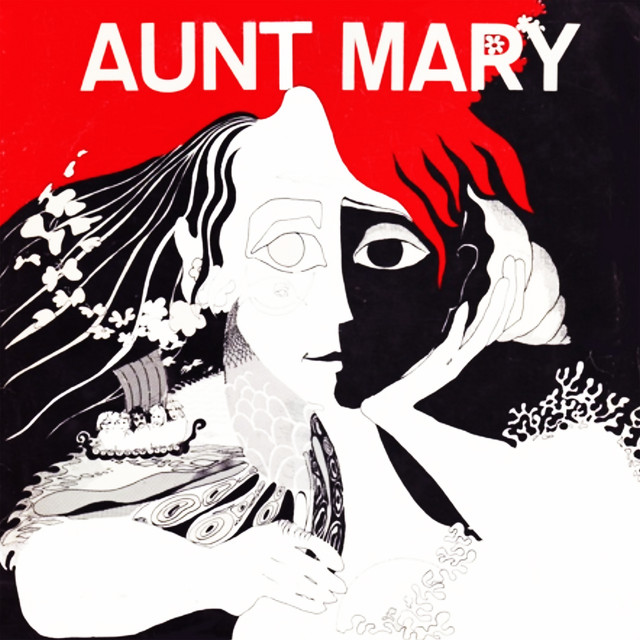
Listening to the eponymous debut from Aunt Mary, my brain hit upon something I had never really considered despite reading about it all the time: Is this what they mean when they refer to “UK blues” versus the more traditional sounds in the US? I think an even better question is, “How does this apply to a 1970 recording from a Norwegian prog band signed in Denmark?” No matter how you slice it, it feels like Aunt Mary was created from an algorithm trained on this blog, and the fact it came out three years before I was born feels more like evidence for time travel than anything cosmic or preordained: if time travel existed, you can bet your bottom dollar it would be used to sell even more to us.
Time may be a flat circle, but never forget it’s also shaped like a coin.
As Wikipedia has the barest of entries and my CD is completely in Norwegian, excepting the credits, here’s what I can tell you. The group, led by Jan Groth, formed in ’69 in Norway, moved to Denmark, where they signed to Polydor Records, and released the record sometime in 1970. Groth, feeling the weight of stardom (however that might be defined for a Norwegian band living in Denmark in 1970), left in ’72. The smaller unit marched on for two more releases before shutting down in 1973.
But coming back to the debut, “Rome Wasn’t Built In One Day” has that slippery R&B groove I love, and the band’s not-so-secret weapons immediately come to the fore: woodwinds. Per Ivar Fure is the standout multi-instrumentalist, providing all the saxophones and flute in addition to harmonica, mouth organ (eww, and yes, they’re listed separately), and vocals. There’s a fun play between organ and acoustic guitar on “Why Don’t You Try Yourself,” and Groth’s vocals slide in perfectly. That one’s probably my favorite song on the record—I love the double-time section when the organ and guitar join on a vamp that leads into Bjørn Christiansen’s guitar solo.

That sense of play runs throughout Aunt Mary, whether it’s the twisted melody that opens and permeates “The Ball” or the sass on Fure’s flute (I can’t help but think of Anchorman here) reinforcing Groth’s pitch-perfect sleaze vocal on “Whispering Farewell.” Even the sequencing embodies the spirit, with the tongue-in-cheek “Yes, By Now I’ve Reached The End” acting as the quintessential closer… except my CD tacks on two more tracks before we’re actually done.
Time-travel sales manipulation or not, I am very much into this record.

Leave a Reply