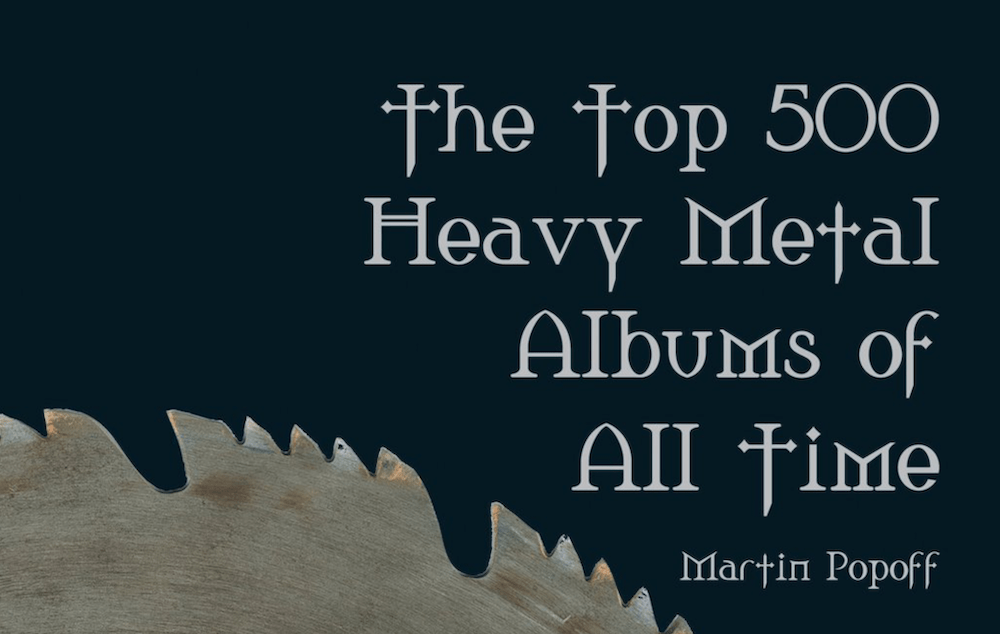
The one fun thing about my recent COVID-laden vacation was sitting back with a thick book of Canadian music critic Martin Popoff sounding off writ large at heavy metal records. Specifically, The Top 500 Heavy Metal Records Of All Time, as compiled via poll over 20 years ago. I’m a big fan of Popoff – even when I don’t agree with him (and that can be often regarding certain bands and genres) he has a very clear, entertaining voice, is deeply knowledgeable about the field of rock and roll, and – most importantly – backs up his opinions and claims. We’ll get a little more into that below, but despite being sick it was a blast to read him sound off on all 500 albums (again – he had no say in what was chosen, so it was a delight to read him rip on particular picks that don’t jibe with his own vision), bringing said albums up in my headphones and listening, forming my own opinions as I went along. And lo and behold: I learned a couple things in the process. 10 things to be exact, so let get over the jump and see what those things are and how they inform the way I consume music in this day and age.
1. Distance and Time Change Everything
Sometimes the rose blooms, and sometimes it withers away. I remember as a kid hearing the double shot of “The Hellion” and “Electric Eye” off of Judas Priest’s Screaming For Vengeance and knowing in the true depths of my heart that this was one of the best heavy metal albums ever created (it’s ranked #12 overall in the book). 40 years later It’s not even in my top 5 Judas Priest albums, let alone the top 10 heavy metal albums of all time. Conversely, Aerosmith were a band I never cared for, coming up with the hits but landing squarely in their late 80s/early 90s resurgence as a teen. It’s only been very, very recently that I’ve grown to appreciate the sleazey rag rock the band was laying down on Rocks (#71, and holy crap “Nobody’s Fault”) and Toys In The Attic (#82). To cite another example, I wish I had been on board with the Coverdale/Hughes configuration of Deep Purple earlier, because Burn (#92) is an absolute banger of an album, and I now prefer it over more “certified” classics like Machine Head (#24).
2. The “You Had To Be There” Factor
There is an almost preposterous amount of 70s and early 80s bands represented on the list, and I think this has to do with who actually filled out the poll (we’ll cover that in a moment) and the notion that – for many of us – the albums we hold closest to us as the “greatest” or the “best” are those foundational albums we experienced as we grew up. So yeah, maybe I had to be there in order to really appreciate bands like Sweet and Desolation Boulevard (#486) or Queen’s News Of The World (#372) and how they would be considered some of the best heavy metal albums ever. Fine albums both, but in the context of how I grew up with heavy metal there’s no way they would ever make my list from a classification standpoint. But I wasn’t really there at the time those albums exploded, and I can’t imagine how they must have come across to folks used to more sedate or pedestrian rock and roll.
On the other side of the fence, in addition to my Johnny-Come-Lately love for early Aerosmith and Mark III Deep Purple, I had no visibility or context around bands like UFO and Lights Out (#298) or early obscure metal classics like Holocaust’s The Nightcomers (#498) and Exciter’s Heavy Metal Maniac (#472), let alone my all-abiding love for the work of Uriah Heep. Those are all albums I came to love decades after their release. Sometimes you need to be there, and sometimes you don’t, is my point.
3. Who Even Fills Out These Polls?
Know where your data comes from. Martin Popoff is a Canadian music writer and critic/YouTube personality (he’d probably hate that as much as I hated writing it) and has a pretty significant following of folks around the same age – let’s say anywhere from late 40s to mid 60s – so I would think the majority of folks completing the poll have a common source of music discovery, with an emphasis on 70s and early 80s (maybe with a slight Canandian perspective, who knows?). Does that automatically negate any of these choices? Of course not: there is no pretense to objectivity here, and Popoff to his eternal credit is almost gleeful in how he writes up some of the entries he’s less than enthused about. Sure, you can lament the lack of representation of more extreme elements, although I was surprised and gratified to see bands like Mayhem (De Mysteries Dom Sathanas, #190), At The Gates (Slaughter Of The Soul, #112), and Neurosis (Through Silver In Blood, #381) find their way on the list. With 20 years of music missing – the book came out in 2004 – there are bound to be omissions, some glaring. But taken as an object of discovery, of possible re-appraisal, the benefits and charm of a book like this is revealed. Even with all the Manowar.
4. Don’t Discount Live or Compilation Albums (Except When You Should)
The second I heard Iron Maiden’s Number of the Beast (#2) I knew I had found a band I would carry with me forever. But I’d be lying if I said that album did the heavy lifting to get me there: all honor goes to the band’s massive Live After Death (#87) which I memorized over a summer so I could pretend I was Bruce Dickinson singing an entire concert in front of my bedroom mirror. I discovered Ozzy Osbourne with “Crazy Train” and Blizzard of Ozz (#15) and was barely aware of the existence of Black Sabbath until someone taped me a copy of Black Sabbath’s We Sold Our Souls For Rock ‘N’ Roll (#233) causing me to fall under the Iommi spell. My first Kiss albums were Alive! (#41) and Double Platinum (unsurprisingly not ranked); my first Rainbow On Stage (#401). Sometimes when you don’t know where to go for a starting place a compilation or live album will do wonders.
That being said, I don’t know who would have put Judas Priest’s Priest…Live! (#408) or Metallica’s S&M (#427) on this list. Shame on you, sirs. Shame.
5. Rick Rubin?
Yeah, Rick Rubin…you know, the wunderkind who positions himself as some kind of hippie mystical guru who tends to lay on a couch and dictate aural guidance when he’s not filming black and white documentaries with Paul McCartney? Yeah, I’m ridiculing him a bit because frankly he’s ridiculous, but there’s no doubt he’s also behind some of the greatest records ever made in the history of modern music, whether you’re a rap, metal, or country fan. That said, it was surprising and and weirdly enjoyable to eavesdrop in on some of the artists who worked with him on these ranked albums (I should mention Popoff included a whole slew of interviews with artists in the book) and how, uh…”unconventional” Rubin’s approach was, or how many of the albums like Trouble’s Manic Frustration (#262) or The Cult’s Electric (#289) sound like they sound because Rubin had an AC/DC fetish going on at the time. Whether he was there the whole time or, as Trouble and Danzig claim, barely there at all, you can’t mistake the vibe the albums he produced give off. When it works, you get Reign In Blood (#3) and Danzig (#175). When it doesn’t…
6. The Role Of A Critic
I didn’t necessarily learn this from reading the book, but I think it bears repeating: a critic’s job is not to reinforce your own beliefs. A critic or reviewer’s job is to provide context and information and their own subjective view around the thing they’re discussing. Any writer or reviewing claiming their take on something is objective should be immediately watched – their knowledge of how words work would appear somewhat faulty. Likewise, if your measure of a good critic is how much they align with your own views, I would suggest you’re perhaps not leveraging the full benefit of what a critic can provide – I would also very politely suggest there are some esteem issues you might want to address. My favorite writers on media, whether it’s music or film, are writers I don’t alway necessarily agree with, but provide enough context and information to inform their opinion and – in the best cases – cause me to reconsider my own views on something. This was definitely the case with Aerosmith and UFO, and as we’ll talk about later, his approach when writing about a lot of the power and symphonic metal like Stradivarius and Visions (#218) or early Angra (Angel’s Cry, #252) helped to reframe my perspective around a genre I’m only just starting to fully embrace.
7. Power Metal
While I might be sad that some of my favorite metal sub-genres aren’t as fully represented on the this list as they could be, I was pleasantly surprised to see so much power metal on the list. Often derided now for what is perceived as “cheese” it’s hard to explain just how big a deal it was in shaping the direction of future metal. Epic songs lengths, super technical and intricate solos, larger than life vocals: all those things easily fall within the tenants of heavy metal, and early bands that straddled the style like Halloween (Keeper of the Seven Keys Part I, #89, Part II, #36) and Queensrÿche (Operation: Mindcrime, #7, Rage For Order, #108) paved the way for other bands to really spread their wings, such as Rhapsody with Symphony of Enchanted Lands (#330), Hammerfall and Glory To The Brave (#285) and even Nightwish (Oceanborn, #409). Seeing the varied scope of what can be considered power metal on this list is frankly refreshing (even with the insane glut of Manowar albums), and speaks to the times and growth of the genre just as much as your favorite cult death metal band who only has demos and splits out on a European underground label and yet inexplicably has a reach across the world wide interwebs.
8. The Egos Are HUGE
I mean, you HAVE to have an ego to get to the upper echelons of your chosen profession, right? Still, to listen to Joey De Maio tell it, Manowar are the only purveyors of “true” metal, the sole keepers of the metal flame. And don’t even get me started on Yngwie Malmsteen, who invented everything about his style, is only indebted to Bach and Paganini, and will tell you he doesn’t need anyone else to realize his perfect neoclassical vision. Much as I enjoy early Malmsteen (the first two records are all-timers), I’ll hand it to De Maio – Manowar have stayed true to a particular style and they have an enormous following across the globe, which helps explain why no less than six albums made the list, with Kings Of Metal reaching #131 (Malmsteen has three, with debut Rising Force just missed the top 100, coming in at #101). You would expect that from those two, as part of the charm is their sense of self and infinite stores of braggadocio, but that level of confidence and “I’m the best at what I do” mentality pervades a lot of the folks who made the list. For someone with decades of self esteem issues, it’s a thing I picked up on.
9. What’s With All The Slavish Devotion?
You love Black Sabbath. I love Black Sabbath. But do you love Black Sabbath so much that 14 Black Sabbath albums need to be on this list? Dehumanizer (#224)? Really? Look, I’ll actually go to bat for Technical Ecstasy (#344) as a fine Sabbath album, but as one of the top heavy metal albums of all time? I get everyone has their entry points into metal, but I refuse to believe those two albums didn’t get immediately tossed aside the second that person discovered Master Of Reality (#25) or Paranoid (#6). For the love of Pete, Headless Cross made this list at #429, beating out the likes of Dillinger Escape Plan, Coroner, and Cathedral, all bands that had huge impacts on the genre. I already talked about the glut of Manowar albums on here, but let’s move to another band beloved by me. Iron Maiden has 10 albums on this list, and for the life of me I can’t make a single case for the morass that is Fear Of The Dark (#237). I’d maybe go as high as six album from them (basically the first six including Live After Death); everything else is bloat no matter how much I may like it. Judas Priest has 13 albums on the list, including…Jugulator at #322? Point Of Entry is on here? Don’t even get me started on the fact that Kiss has 11 albums on here (Alive! is the highest at #41), and there’s maybe only 4 I’d ever listen to.
This reinforces something I’ve been thinking about a lot: the tendency to give band you love a pass instead of really critically listening to what they’re putting out. I adore Iron Maiden, Priest, Opeth…but I’ll also be the first to admit (and I did on our Nine Circles Mid-Year Round Up) that there was no way this year my beloved Darkthrone was getting a nod as an AOTY contender. Being open to what your favorite bands are doing is NOT the same thing as giving them a free pass.
10. What Even IS Heavy Metal?
I think at the end of the day, what Martin Popoff, The Top 500 Heavy Metal Albums of All Time, and any list or ranking of metal albums speaks to one thing: genre is elastic, and is rarely if every fixed or set in stone. For someone coming into Budgie’s debut (#387) in the early 70s that explosion of loud sound marked a change. For someone else it might have been getting a brief taste of European speed with Destruction’s Infernal Overkill (#263). Maybe there was a jaded teenager out there who didn’t consider any of it really heavy, but then heard the furious mix of keyboards, lightning fast guitars and screams that were almost indecipherable and realized that for them, Emperor’s In The Nightside Eclipse (#153) chimed the genre in their now bleeding ears. The genre is determined as much by who, where, and when we discovered the music as by the foundational tenants of the sound. Who’s to argue that Nightwish or Tiamat or even Poison (Look What The Cat Dragged In, #442) don’t belong? Or that the genre doesn’t stretch as far back as Cream (Disraeli Gears, #404) or Jimi Hendrix (Are You Experienced?, #256)?
Me? I’m just happy to have discovered more music to get acquainted with. Oh, and that Crimson Glory’s Transcendence made it at #206. Always loved that album…


 Consuming the Tangible
Leave a comment