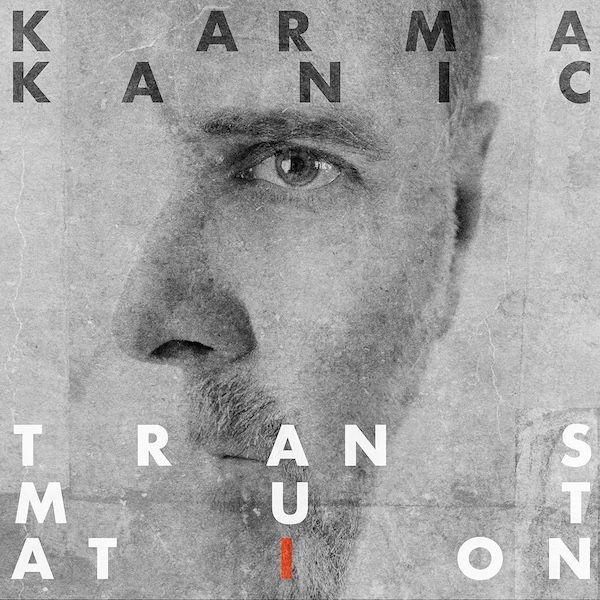
Expectation’s a funny thing. So are solo projects, and the two intertwine when someone who’s not the leader of a band goes out and does their own thing. Jonas Reingold has been the king of prog rock bass for decades now, whether it was supporting The Tangent or The Flower Kings or – in his most current guise – as the main support for Steve Hackett. But on his own he’s the brain behind Karmakanic, which since 2002 has been putting out their own spin on modern neo-prog. It’s been nine years since the last album, bringing a lot of expectation on what Transmutation should sound like. Surprise: with a massive rotating guest list it sounds a little like all those bands, but not quite like any of them.
So what does it sound like? Lush, modern progressive rock where Reingold’s bass swirls, twirls and dances through the arrangements in a number of styles. It’s a bit of a mishmash of different vibes, a showcase for Reingold’s interests and influences. I don’t have the biggest background or baggage with the band, so Transmutation acts as an introduction to Reingold’s songwriting. It opens with a short but killer instrumental, the rocking “Brace For Impact” featuring Andy Tillison of The Tangent on organ and clavinet and the great Simon Phillips on drums. I can see where a lot of people would love an entire album of this kind of music – to be fair I would, too – but Reingold has other ideas on his mind and in his fingers he wants to get out. Still, great track and exquisite solo from his longstanding guitarist Krister Jonsson.
Things change a lot on the 10-minute “End Of The Road” which feels the most like one of his former bands. This has The Flower Kings written all over it (though one notable absence here of all his friends and guests is Roine Stolt) and it’s a pretty, uplifting song with a dual lead vocal performance from John Mitchell of Frost* and Randy McStine. It also has some great guitar work from Luke Machin from The Tangent, but again, this is Reingold’s show, so the standout to my ears besides the melodies is how smooth Reingold’s bass weaves through the song, never content to sit in the background but also never doing anything less than exactly what the song requires. “Cosmic Love” has a bit of Asia flavor, and it’s a kick to discover that besides Frost*, John Mitchell also is in the most current iteration of that band. Really great driving bass sound here, coming in after the keyboards (also by Reingold) the song is epic 80s AOR without remotely sounding trite or corny. And at under five minutes feels like the obvious single of the album.
From there it’s the feel-good mellow vibes of “We Got The World In Our Hands” but there’s no mistaking the way the bass and keyboards take what could be an overly saccharine song and make it zing. It’s also possibly Mitchell’s finest vocal performance on Transmutation; his naturally lower register voice hits some nice high right before the solo section. “All That Glitters Is Not Gold” opens with accordion but soon settles into a somber acoustic guitar, Reingold’s bass flitting throughout. When the song hits with some crunchy guitars and the rock it jars you into remembering this guy has worked with some dynamic players in his day, and the Zeppelin/”Kashmir” vibes are strong. A sudden shift to a sax solo is a welcome surprise before returning to the chorus and that rockin’ hook before another sax solo brings us into “Gotta Lose This Ball And Chain” which has some fun keyboard sounds and a little more of that heavy “Kashmir” vibe but might be the one song I kind of lose track on.
That’s leaves us with the true monster epic: the 22-minute title track, featuring everyone including Mr. Hackett on classical guitar and a great co-lead vocal from Dina Höblinger. More prog rock royalty abounds with Nick ‘D Virgilio from Spock’s Beard and Big Big Train on drums, and Andy Tillison returns with the Hammond. It’s an embracing of all the styles that permeated the album so far, with plenty of little solo excursions and sense of grandeur, particularly on the track’s second half. You even get a little fusion as Krister Jonsson trades solos with Lalle Larsson, Reingold’s longstanding sidemen in Karmakanic.
Outside of the very on the nose lyrics (still refreshing for some positivity that’s not dripping with overt Christian symbolism, a’la Neal Morse or Roine Stolt) that mask Hackett’s sublime acoustic contribution, the track ends with some power, and Transmutation succeeds in not only once again demonstrating why there is probably no better bass player alive right now in any genre, but that Jonas Reingold has a lot more to contribute in the songwriting department, and his gathering of likeminded souls to play and explore in the musical space shouldn’t be spaced so far apart in the future.


 Consuming the Tangible
Leave a reply to Goblin: Roller (1976) – Consuming the Tangible Cancel reply