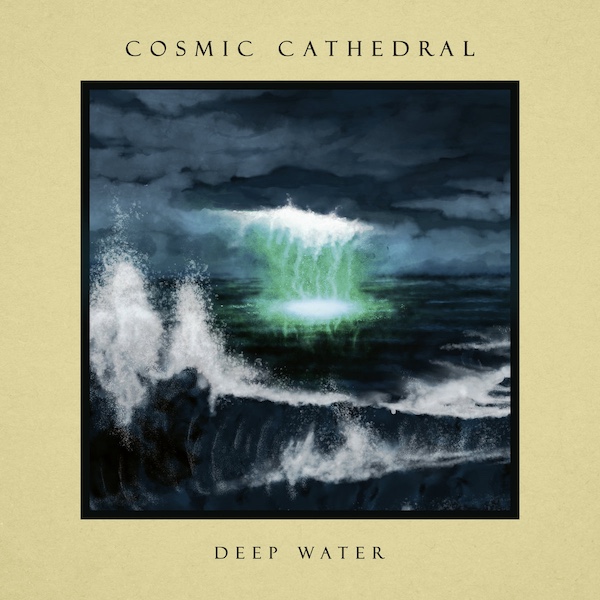
Is Neal Morse even capable of taking a break? Since 1995’s debut with Spock’s Beard it’s hard to find a year where the man hasn’t put out music, whether with his various group projects including Transatlantic, The Neal Morse Band, and Flying Colors, his trio with Nick D’Virgilio and Ross Jennings…the list goes on, and doesn’t even begin to cover the various solo works since his conversion to Christianity and leaving Spock’s Beard. Last year’s No Hill For A Climber showed what Morse could do with a bunch of younger musicians working his tried and true prog rock template, and this year he switches things up slightly by forming Cosmic Cathedral, wrangling in a bunch of veteran players like Chester Thompson and Phil Keaggy to give us Deep Water, a collection of heavily Christian-themed progressive rock that largely remains within Morse’s wheelhouse while offering a few new subtle shades thanks to his sidemen.
With over 50 albums to his credit – many of them double albums – even a cursory knowledge of his output should give you some idea of what to expect with Deep Water, and you’d be right. Opener “The Heart Of Life” is almost standard-issue Neal Morse: sweeping overture opening introducing the themes throughout the 14-minute track, some cool syncopated breaks that rock, showing off the chops of bassist Byron House, a veteran session player who’s worked with Robert Plant and Dolly Parton among others. It’s followed by a killer jazzy solo from Keaggy (the least known quantity for me, he’s a breakout star on Deep Water) before opening into the song proper. I like the more 80s AOR tilt of the music during the vocal part of the song, particularly Morse’s keyboard stabs and how well House locks into Thompson’s drums. Morse is nothing if not a master of crafting insatiable vocal hooks, and paired with Keaggy’s higher register harmonies the chorus is an absolute winner – provided you can get past the very, very overt Christian themes.
It’s impossible to look past Morse’s conversion to Christianity and how that shapes his entire worldview, and honestly it’s not something I really mind despite not being religious. If I can listen to a thousand albums espousing the chaos of Satan, I’m not going to blink at a bunch of Jesus references, provided it’s not pushing viewpoints against my own worldview. Really Morse’s lyrics amount to one of two things: he’s either telling a conceptual story from the Bible as his does on many of his other recordings, or he’s simply reveling in how he was saved and saw the light thanks to God. I’m fine with it, even if it can get on the nose and preachy at times. He more than makes up for it on the musical side, and listening to him now I keep coming back to just how essential his sidemen are to his process – this would be a very different album if handled by his previous NMB lineup with Mike Portnoy and Eric Gilette, or even his Resonance outfit from last year. With Deep Water the music takes an elder statesmen approach thanks to the veteran lineup, and while that lessens some of the aggression I tend to gravitate to in his music, it at least breaks up the sameness of his continued output.
Sandwiched between epics are three shorter tracks, and much as I want it to be otherwise, this is where Deep Water falters a bit for me. “Time To Fly” offers a lot of small nuances that are fun: there’s some backwards guitar, beautiful female vocal harmonies, some backward guitar licks, and a sax solo from Mark Leniger. There’s been a lot of press about this being Steely Dan influenced by Morse himself, and this perhaps gets the closest with its blocky keyboard chords and horn accompaniment lending a jazzy funk vibe to the song. It’s pleasant and harmless enough, but it leads into “I Won’t Make It” which just kind of flounders in a haze of acoustic worship music. It’s a jarring break from the vibe of the album, and it’s hard to hear how this was constructed other than Morse had a song lying around and wanted to include it. Thompson’s drums do little to lift it up, and Keaggy’s brief solo feels like an obligation rather than a true partnership. Speaking of Keaggy, the final song “Walking In Daylight” features him taking the lead vocal spot, and with its extended keyboard opening and syncopated stabs is the highlight of the shorter songs, though “short” is relative here as it sits close to nine minutes. Keaggy has a high, reedy voice and it works well here, especially when mixed back with Morse’s strong lead voice during the chorus – there is a Beatles-esque vibe to their harmonizations. The guitar work is fantastic, and this where Morse’s music really shines: when he lets his sidemen have a large chunk of the floor to show their moves off.
Finally, there the “Deep Water Suite” and at 39 minutes long (stretched over two sides of the vinyl) it’s the track everyone who loves Neal Morse was waiting for. The overture is a monster: after some pitch-shifted vocoder things kick off with a bang, and despite some of my misgivings about the album overall this might be my favorite “epic” track Morse has put out in the last few years. Everyone is really grooving here, and if I’ve been light on praise for Chester Thompson and Byron House they more than make up for it here. Divided into nine sections, Morse pulls out all his keyboard tricks, and allows the band to finally get some heavy riffing in as the verses come in on “Launch Out Pt. 1”. But Phil Keaggy….damn. His guitar playing is astounding, pulling these killer licks and runs throughout the track like a guy 40 years his junior.
The suite moves through a number of different vibes, from the more delicate AOR pop of “Fires Of The Sunrise” to the wicked prog instrumental break of “Storm Surface” and extended rocker “Nightmare in Paradise” with some great bass soloing from House. The primary theme established in “Launched Out Pt. 1” comes back on Parts 2 and 3 before the whole thing closes with “The Door to Heaven” which is fine even though lyrically I struggle overcoming the much more overt Christian imagery (it’s hard to get enthused singing lines like “I sing for Jesus / it was for me He died / He unlocked the door the heaven / now we can pass from death to life“) but even worse: it feels bland , nine minutes of classic AOR rock that doesn’t have the ingenuity or exciting melodic passages I got from the rest of the album.
Still, it’s a small price for an otherwise fantastic epic, and with the opening track and “Walking In Daylight” there’s enough in Deep Water to have me periodically come back to Cosmic Cathedral. And I’m sure it’s only a matter of time before Morse jumps into something else, anyway.


 Consuming the Tangible
Leave a comment