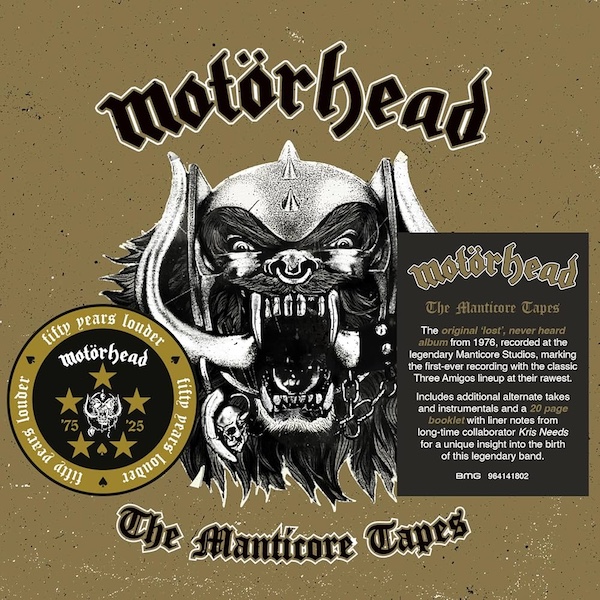
First breaths of a band are a tricky thing. It can take a few years – hell, it can take a few albums – before a band achieves that singular cohesion of function and form. Being kicked out of Hawkwind, Lemmy Kilmister knew EXACTLY what he wanted to become: the ugliest, dirtiest rock and troll band in the world. But despite the clear mission statement, it took a year to drudge up the exact combination of filth – namely, “Fast” Eddie Clarke on guitars and Phil “Philthy Animal” Taylor on drums – to truly make Motörhead the band Lemmy needed it to be. The Manticore Tapes bring to life one of the earliest recording the classic trio did, a series of recorded rehearsals at Manticore, the headquarters of Emerson, Lake, and Palmer. Don’t call it a “lost album”; call it the birth of a sound that would continue to make your lawn die 50 years later.
Excepting the opening instrumental track called, simply, “Intro” (though Lemmy calls it “Instro” which I prefer) with its twists and turns and extended solos, most of the tracks recorded during this season made their way onto the debut – both the released eponymous album and the actual debut released a few years later as On Parole. You get mainstays like “Vibrator” and the Hawkwind-ish “The Watcher” as well as the band’s immortal namesake tune and the raging “Iron Horse/Born To Lose” but let’s stay on the opener for a second, because it shows off something that becomes clearer as you progress through The Manticore Tapes. Not only was the band incredibly tight only a year into their life, but the technicality on display is kind of marvelous for a band wanting to be the loudest, ugliest band in the world. Clarke is a monster guitarist, and his lead work is fantastic, often going in dynamic directions under Lemmy’s chordal bass work. Phil Taylor could bash the drums like the flithy animal he’s named for, but he also knows exactly when to hold back. His playing is never excessive, sticking to the tried and true rock and roll formula that serves as the foundation for a lot of Motörhead’s early work.
And Lemmy? The clear, unadorned recording captured by Ron Faucus on Ronnie Lane’s mobile studio at Manticore shows that even with only a modicum of distortion Lemmy always sounded like Lemmy. Playing more like a rhythm guitarist than a bassist, he could chug along with the best of them and also slink and slide around the riffs as needed. The recording allows a clear separation and it’s a fantastic opportunity to really hear how Lemmy and Clarke combined their tones to create this hairy rock machine. “The Watcher” is a standout for my money – getting to hear the song slowly build into this dreamy connective tissue between Lemmy’s stint in Hawkwind and where he would go with Motörhead is a real treat, and though I tend to rock more to “Motörhead” and “Iron Horse/Born to Lose” with its Sabbath leanings, my heart loves “The Watcher”.
I’m still slight in my physical collection of Motörhead albums. I knew tracks like “Ace of Spades” but my first purchase was the much more metal Inferno from 2004. I’ve been backwards and forwards since then, but hearing The Manticore Tapes gives me a completely new appreciation for how Lemmy, Eddie, and Phil stuck to their guns for so long, and made it work like gangbusters. If you’re a fan of the band you may have heard some of these before, but the restoration job brings a life to the tunes that brightens me up immeasurably.


 Consuming the Tangible
Leave a comment