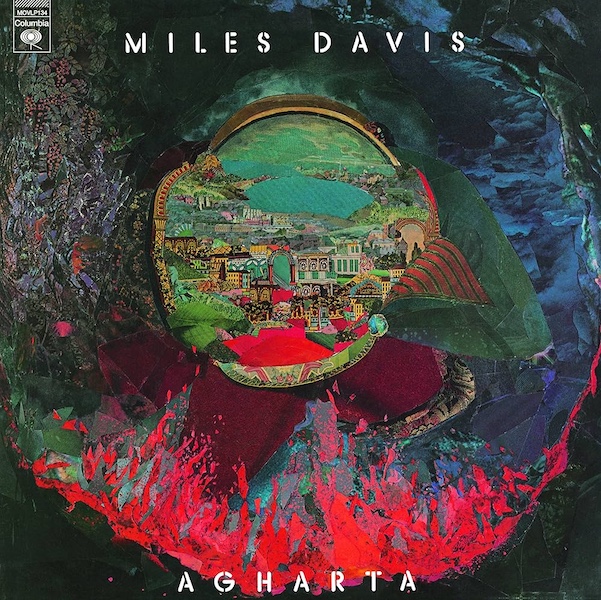
Where does a listener start when it comes to the “electric period” of Miles Davis? Where does the “electric period” even begin? Miles and the second quintet were using electric instruments as far back as Miles In The Sky (a personal favorite) but it seems like most folks peg it at the ambient, rolling atmosphere of In A Silent Way (another favorite). Where listeners start, though, is another matter. For me it was unfortunately with Pangaea, a live set from Japan that at age 17 I was not prepared for. Had I only started with that same date’s afternoon set, the brilliantly funky Agharta, I might have more quickly embraced this side of Davis’s career instead of retreating back to the early 60s for much of my 20s and 30s.
Recorded in the afternoon of 2/1/1975 at the Festival Hall in Osaka, Japan, it’s immediately apparent that Miles’s health has him taking a back seat when it comes to the performance, but his presence is felt in every moment from an orchestration perspective. But when he does come, he does so with intent, ensuring the breath he does have is used for maximum impact through the lengthy improvisations on Agharta. His solo break doesn’t come until almost 20 minutes into opening track “Prelude, Pt. 1” but when he does you can hear all the influence of Hendrix and Sly Stone in his phrasing, his signature muted squawk echoing Hendrix’s wah pedal while slipping around a Sly Stone funky vamp that rivals the best moments of On The Corner.
Make no mistake, though: this is Davis’s band’s time to shine. After the funky excursion for the whole gang on “Prelude, Pt. 1” guitarist Pete Cosey uses the six minutes of “Prelude, Pt. 2” for an extended solo that goes out into the cosmos and stays there. I can hear Eddie Hazel in his playing, especially the nasally tone he gets out of his instrument, and honestly I don’t understand the flak he gets in the forums: maybe it’s my ears, but he doesn’t sound too up front in the mix, and his playing meshes beautifully against the foundation laid out by bassist Michael Henderson and drummer Al Foster.
This music lives or dies by that rhythm section, and it’s complemented by James Mtume on percussion and Reggie Lucas on rhythm guitar. The ease with which the band lays out smoldering funk next to ethereal and spacious ambience is the perfect launchpad for the soloists to lean in and explore. Besides Davis (who takes another meditative, thoughtful solo on “Theme From Jack Johnson“) and Cosey there’s also Sonny Fortune on alto and soprano sax and flute. That flute is featured on “Maiysha” which is another highlight on an entire set of highlights.
In the end Agharta shows how Davis can still dominate a show without actually being the star of it. Besides, who else would title a 26-minute improv as “Interlude”? Love it.


 Consuming the Tangible
Leave a comment