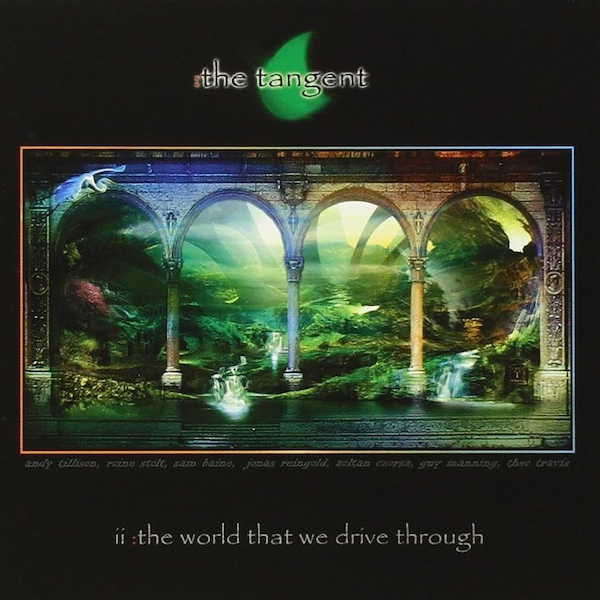
When you think about it, The Tangent is kind of the perfect name for Tillison’s ongoing musical exploration. This early in the band’s career it could be construed as a tangent to the players’ other ongoing projects (Roine Stolt certainly took it that way, as this is his last hurrah with the band), but it’s also a good indicator of the musical direction: tangential to numerous styles and genres, beholden to none. Only a short year later that use case continues to hold true with their sophomore album The World That We Drive Through. Almost a half hour longer than the debut, it’s a more ambitious, expansive offering, relying less on compact passages and segues and building them into beefier song structures. It’s a less immediate but still gratifying album – with caveats – to my ears.
The main album is five songs spread over three sides (vinyl, y’all) with one massive cut, “A Gap in the Night” taking up all of Side 3. But it all starts with “The Winning Game” and that mellotron. Stolt may be leaving after this, but not without some fabulous soloing first. David Jackson is already gone, but he’s ably replaced by Theo Travis on sax and flute. The song has some serious groove and funk over its 11 minutes, and lyrically Tillison continues to mine darker subject matter, writing about isolation and solitude, the lonely nature of a world obsessed with the NASDAQ and the unattainable status of “winning” as the planet slowly slips away. Love the ending Stolt solo as Tillison throws a little Burt Bacharach reference in the end. “Skipping the Distance” finishes off the first side, and it’s an even more funky affair, the synthesizers and flute conjuring some late 70s soundtrack before moving smoothly into its main groove. Some really great extended keyboard sections here, sometimes playing against each other – a huge benefit of having Sam Baine as a second keyboard player in the band. It’s more a showcase for the band’s playing than anything else, and I’m here for it.
Side 2 kicks off with the shortest track at 7:40 with “Photosynthesis” and its pretty opening emphasizes the British-ness of the music, despite half the band coming from Sweden. Despite a lot of modern flourishes, songs like this make it easy to remember the huge debt to UK prog and the Canterbury scene The Tangent is indebted to. If there’s a not-so-stealth MVP here and throughout The World That We Drive Through it’s Theo Travis: his flute in particular is always a highlight. That said, it’s also the first song that leaves me wanting, feeling less than inspired. From there it’s on to the title track, one of two (well, three if you count the bonus tracks) epics that close out the album. It’s a slow-moving start that gradually amps up until the instrumental breaks soar. Roine Stolt doesn’t have any writing credits on the album (though he’s listed as a co-producer) which might explain the lack of lead vocals from him but his soloing is 100% on point. And especially here, where he’s backed by the jazz-fire chops of Zoltan Csórsz on drums. In certain section I can hear Tillison channeling Ian Anderson vocally; I wonder though if that’s just because Jethro Tull are such a touchstone for me, part of my DNA so when I hear music like this and try to draw comparisons my brain instantly travels those roads.
Those are the kind of questions I love to suss out and think over as part of the mission of this blog.
Anyway, another thing I was thinking of as I was listening to The World That We Drive Through is that Jonas Reingold feels largely restrained. Folks, allow me to present to you the last 4 minutes of the title track where he goes absolutely nuts with Theo Travis skronking away on sax. It’s probably my favorite moments on the entire album.
That leaves “A Gap in the Night” to take up all of Side 3 to formally close out the album. Billed as “In Darkest Dreams – Part 2” it’s a musical sequel to the opening epic from The Music That Died Alone (don’t worry – it gets even more confusing later when we review A Spark in the Aether which is the sequel to the whole debut album). When you have 18 minutes to spend you get a modicum of patience with your opening, but it’s a little too sedate and ominous for my taste. The song is broken up into nine sections, but after the 1000+ word slog from the last album I’ll keep my thoughts more general here. After about three minutes it picks up a bit, and one of the things that really comes through on this track is how – with a minimum of three talented singers – you can craft up some juicy group vocals. Really love the organ when the song gets moving. It goes psychedelic in its middle section, but then picks back up for more rocking interludes before concluding.
And normally that would be it for The Music That We Drive Through, except Tillison isn’t content to leave a vinyl side empty, so on Side 4 we get a whopper of a bonus track, the 14-minute synth-strumental (let’s make it a thing!) “Exponenzgesetz” which is really an extended three-keyboard workout that at times gets downright cinematic in its approach. If I think about the album as a whole, it’s more ambitious but maybe less accessible and successful than the debut, but the extended musical passage and solos are fantastic, and whatever sorrow I have at Roine Stolt’s limited presence in the songwriting and performance aspects, I take solaces in the massive Flower Kings library we’ll be reviewing in time on this site.



 Consuming the Tangible
Leave a comment