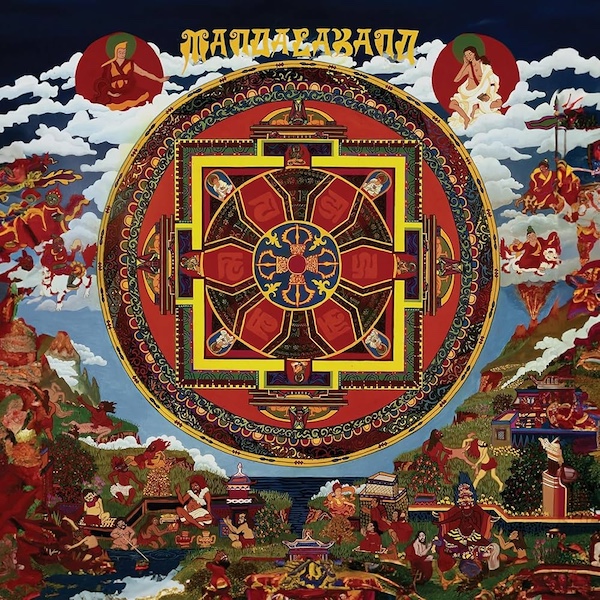
Another impulse buy based off word of mouth from the prog community. I had never heard of Mandalaband, the brainchild of David Rohl which blended together the symphonic-heavy prog that was burgeoning in the mid-70s with a healthy dose of Tibetan mysticism and fantasy-driven lyrical themes. There’s a fair amount of hippie-drippy bombast as well in the melodies, and if you’re like me and never heard of the band before there’s probably no better place to start than Legacy – The Story of Mandalaband 1975-1978. Covering the first two albums – the self-titled Mandalaband and the almost-soundtrack The Eye of Wendor: Prophecies – the box set contains not only the original mixes remastered, but newly remixed versions of both albums by David Kohl with additional demos and alternate mixes.
Released in 1975, Mandalaband may be the band’s introduction, but it certainly wasn’t what Rohl intended. Having conceived, written, and engineered the demos that got Chrysalis (home to Jethro Tull among others) excited, Rohl was also set to produce but at the last minute was sidelined in favor of someone with more experience. When the sessions didn’t meet the label’s expectations, Rohl was brought back in to try and salvage the recordings with a mix, but he was never satisfied.
Others were, though. John Peel loved it, and played the album back to back on his radio show. I can hear the reasons why, too: despite the misgivings Rohl may have had the album has a real unique and flamboyant sound, starting with the 20-minute opening track “Om Mani Padme Hum (In Four Movements)”. It’s a true suite, the keyboards and percussion taking dominance accompanied by Tibetan chants and mantras. Rohl’s 2024 mix dials back the bombast a little, allowing the arrangement a little more room to breathe but honestly beyond that the changes are pretty subtle. More valuable in the set is the original Camel Studios demo that got the label excited. Elsewhere on Mandalaband the tracks range from the funky rock of “Determination” to the regal and subdued “Song For a King” and driving “Roof of the World” which has a fantastic gallop. It’s also a great showcase for the players, including David Durant on vocals, Ashley Milford on guitar, Vic Emerson on keyboards (apparently all great keyboard work is associated to an Emerson), John Simpson on bass (he also wrote “Determination” and the final track “Looking In”), and Tony Cresswell on drums.
It’s with a new band (and a lot of guests, including Noel Redding) and a new freedom that Rohl returned to start creating what would come to be The Eye of Wendor: Prophecies. Originally conceived as a soundtrack to a planned film adaptation of The Lord of the Rings, when financing fell through Rohl came up with his own fantasy take, creating a full story and mythology that would serve as the backdrop for the new album, Wrangling in friends including Barclay James Harvest, the Moody Blues and 10cc the final result is an astonishing array of musical styles held together by Rohl’s keen ear for arrangements. Far from simply orchestration (what remains of the LotR soundtrack can be found on the track “Silesandre”), tracks like “Florian’s Song” and “Ride to the City” have shades of disco and Steely Dan jazz/yacht rock nestled alongside more ethereal tracks like “Ænord’s Lament” and “Like the Wind.”
When the band starts to really cook, as they do on late track “Funeral of the King” it sounds great, but personally I’m more inclined toward the jam-based rock on the debut. I don’t know if I really needed two versions of each album, but overall the discovery of Mandalaband is a happy accident, and a fun record to put on when you want to chill out and then suddenly hear a snippet of something that makes you want to get up and dance. Good enough for me.

 Consuming the Tangible
Leave a comment