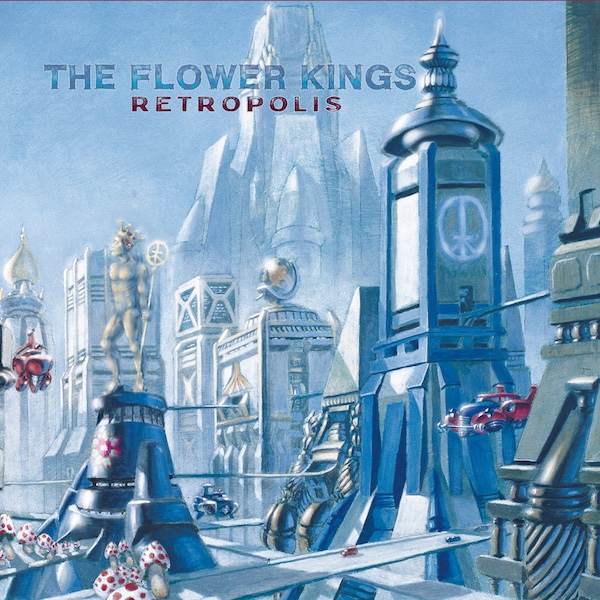
In the new liner notes to Retropolis, Roine Stolt notes two things that at first glance may seem at odds with each other, but I think really encapsulates something that has always been a tenet of the music of The Flower Kings: with the enthusiasm for the first album the band was excited to dive back in and chase the structures and feelings of Stolt’s prog heroes (and peers at the time of his start) but he also actively tried to get the attention of the major record labels in Sweden. That dichotomy of blending the unique and niche progressive rock sound with more mainstream acceptance is something I hear a lot in the band’s music; and it’s interesting to hear how that does and does not come across on their sophomore release.
Everyone from Back in the World of Adventures returns, this time with Hasse Fröberg taking vocal duties on four tracks and Ulf Wallander providing his sax on two. It’s an interesting choice to open the album with two instrumentals. “The Rhythm of Life” is more an intro than anything else, the song of someone playing ping-pong before breaking something as a disembodied voice intones the song’s title. From there the Tomas Bodin’s mellotron returns for the 11-minute title track, and it’s a more cinematic, majestic track, lots of orchestral flourishes and striking percussion before the main theme appears, announced by Stolt’s guitar. As usual he sounds fantastic, and the whole band gels nicely, but I have to admit beyond the solos and the repeated themes covered it doesn’t have nearly the same “grab” that either the debut or The Flower King had with their tremendous opening title tracks. More successful though no less dour is “Rhythm of the Sea” which maybe not so coincidentally is the first vocal track on the album. With a more traditional song structure there’s room to still stretch out the solos, and I think it’d make a really fantastic later track, but the first three songs put Retropolis in a position where it has to make up some ground, and that’s not the way I would start an album. What makes it even odder is typically that’s not how TFK start an album, either.
Things pick up on Side B, starting with the uplifting “There is More to This World.” At 10 minutes it feels a little long, but we’re back on poppy, slightly funky ground and after the first few verses and choruses we get into the lengthier instrumental sections. For those listening closely Stolt’s Christian themes become more apparent, but it’s a more subtle, less direct inspiration than, say, Neal Morse who wears his faith directly on his sleeve. No real opinion one way or another, but now that I hear it I tend to look closer to see how Stolt manages it. Also hey Hasse Fröberg shows up in the second half and holy shit this guy’s got a capital V Voice, and it blends really nice with Stolt’s style. “Romancing the City” is a brief piano piece which leads directly into “The Melting Pot” which has Wallander introducing the theme on sax before the full band backs him up. Overall it’s another somber affair, expressing musically the ideas conjured up by the album’s title: a retro-futuristic world where confusion and anxiety reign, with flashes of hope. Solos are great, Stolt has a great Zappa style on his sections, and Bodin’s organ at the end is super impressive (innuendo not intentional but gratifying all the same) but I’m still overall not enthralled with the record.
That changes for me with “Silent Sorrow” which kicks off Side C of Retropolis. The first half is simple enough and super catchy, but when the first solo kicks in the whole feel and tempo changes, and it’s finally a real taste of what I love about the band. Jaime Salazar is on fire throughout the song, adding all sorts of flurries and accents to his drumming, especially on the cymbals. It’s Bodin’s turn to ramp up the Zappa influences on his solos, and there’s some real specific callbacks that are a delight to a Zappaphile like myself.
(yeah, we’re eventually doing all of Zappa’s discography – hence the section reserved in the menu)
The thought I keep coming back to again and again with Retropolis is I wish I liked the full songs instead of just the solos and instrumental breaks within the songs. Case in point “The Judas Kiss” which lays the Christian themes on pretty thick, making for some awkward sing-alongs: “Curtains are down for the Nazarean / He’ll carry the crossing the world will go free” but the song is saved by the great solo sections in the break. “Retropolis By Night” is all glitch and dissociated comm talk, an aural vision of the underground city in the dark, and it’s a cool if ultimately empty experiment in ambience before moving to another instrumental, “Flora Majora”. I wonder what would have happened to the album if it led with this instead of the title track? Finally we get the “The Road Back Home” and it’s a solid closer, especially having Wallander’s sax come up.
Overall I feel like Retropolis is a real step back from the more rocking and accessible debut. Stolt mentions in the remastered vinyl’s notes that a lot of these songs were done at the same time as Back in the World of Adventures, but if they didn’t make the cut there I don’t know why they would make the cut here. A few tracks late in the album aside, it’s not one I’ll revisit often, instead turning to the two albums that follow.

 Consuming the Tangible
Leave a comment