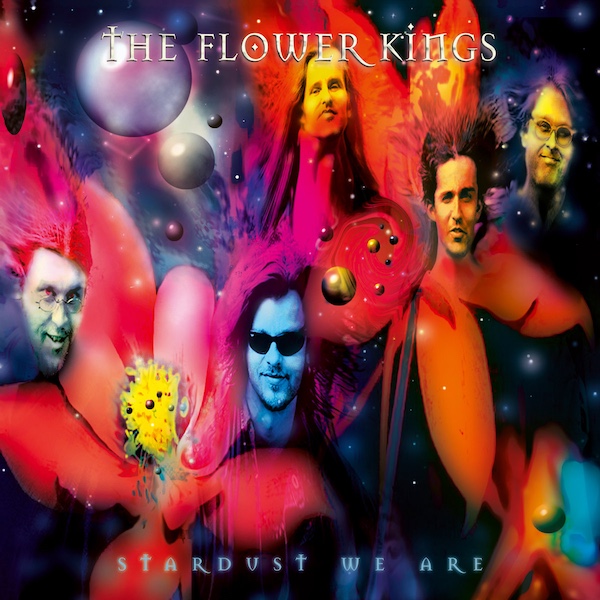
For a lot of fans, this is it. The album where The Flower Kings not only hit their stride, but their peak. Stardust We Are is the band’s first double (triple?) album, stretching over six sides and two hours. The group remains intact, but the process of being together and touring over the past few years has tightened everything up, allowing for broader experimentation in arrangements and orchestrations. It might not be the pinnacle for me – I have minor quibbles – but it’s certainly a highlight of the band’s discography. It’s also a bear in terms of length, so let’s cut the intro chatter and jump into the belly of the hippy, trippy beast.
Now this is how you kick off an album. After a brief orchestral sweep, “In the Eyes of the World” brings the groovy, disjointed rhythmic figure that, after some killer fills by Jaime Salazar builds into one of the main themes of the album. It’s grand, setting the tone for what’s to come, and doesn’t forget to rock. Roine Stolt sounds better vocally on each record, and now that he’s integrated Hasse Fröberg completely into the band, their voices blend beautifully over the lyrics. His guitar work remains, as ever, sublime. The instrumental section takes some unexpected turns in mood, letting him really rip some high gain leads. Tomas Bodin has some wicked organ and synth work as well, showing the melodic trust and partnership between him and Stolt solidify.
One 10+ minute epic already done and we’re off to the races. Stardust We Are is basically a handful of epics with smaller interludes and segues radiating outwards, acting as the connective tissue to the album and, honestly? It’s a little bit of a strain. At 130 minutes there’s a bit of padding, but it’s a great start, with “A Room With a View” serving as a tasty Bodin spotlight, soothing and padded with 80s synth vibes before the anarchic intro to “Just This Once.” When the main melody hits right before the verse it’s beautiful, catching those symphonic Yes waves and putting a little Tull in with Bodin’s descending arpeggio figure on the keyboards. Again, strong solo section that gives everyone room to breath and opens the song up.
Conceptually the album tackles (best I can figure) the theme of identity and our place in the universe, using a young man moving through various stages of life to realize at the end that, well…stardust is all we are. There’s not a lot to grab onto narratively, which is fine since I’m not a huge lyric guy and that remains one of Stolt’s weaker points, writing in broader platitudes and vague ideas. Fine for a prog album: I suspect no one is coming here for the words.
Side 2 opens with another big epic, the more AOR and newly remixed “Church Of Your Heart”. Do I need to eat my previous words? Because the chorus is fantastic. Shades of “The Flower King” with its talk of stars being your blanket and the moon supplying the light. Hearing Fröberg after the huge organ clash is a delight, and the song hits those ballad highs without sounding too saccharine. Time constraints for vinyl mean some re-sequencing is in order, so it’s followed by a few shorter instrumental pieces and “Hidden Dust”, previously a hidden track coming at the end of “Compassion” which originally closed the first disc. Of the instrumental tracks “Poor Mr. Rain’s Ordinary Guitar” is a lovely acoustic guitar piece, accompanied only by the sound of rumbling thunder. “The Man Who Walks With Kings” stretches its wings at five minutes, and opens very Tull-ish, Stolt’s acoustic guitar mixing with Bodin’s keyboards. The folk elements shine through, and it’s fine, especially when Stolt blazes through with his solo. “Hidden Dust” now moved from its shadowy corner behind “Compassion” sounds like a natural extension from “The Man Who Walks…” even though it’s a glitchy, electronic soundscape and nothing else.
40 minutes in and the superfluous nature of “Hidden Dust” aside we’re cooking with gas. But we’re not done with instrumentals by a long, as Side 3 is 75% instrumentals, with the massive 12-minute “Circus Brimstone” starting things off heavy and very much in the vein of King Crimson. Bodin is the hero here, his work is lovely throughout but really stands out here in both lead and supporting roles. I won’t say the entire song is a success: that middle section can get downright weird (it personifies the title pretty well, though) and is more of a distraction than anything else. “Crying Clown” is a minute of something I can’t even recall unless I replay it. “Compassion” gives us an actual song, Stolt’s Christian leanings coming back into the fold more overtly than before. Some strong soloing but honestly this is an entire side of music I can take or leave. “Pipes of Peace” closes out the side on the vinyl despite opening the second disc in the original sequence.
Maybe I’m in the minority here, but it’s always a weird thing for these 90s records that were originally CD only – you have to make some concessions to the timing constraints of vinyl, but I think each change Stolt makes for these releases really work. Does that mean the songs are essentially interchangeable? Am I listening “wrong” because it’s out of order from the original listing?
Does it matter?
“The End of Innocence” feels like classic Flower Kings. Lots of little guitar licks pepper the track, Bodin gets a lot of effects and different tones in, and I haven’t mentioned Michael Stolt’s bass, which feels more relegated to low-frequency support than in the past. Ulf Wallander is back in the fold on soprano sax, but so far hasn’t made his presence known on this re-listen – another problem with really long albums digested at once. This is also the first re-issue without liner notes or listings for who plays on what, so I’m maybe more lost than usual. “The Merrygoround” is a rarity: another vocal number right away without any kind of segue or interlude. Love the bouncy nature of the tune, and I think this is where my Flower Kings sweet spot is. Lively, lots of harmonies, and some stellar drum workouts from Salazar and I’m assuming Hans Bruniusson who’s listed on the album as “drums, percussion.” Outside of the final track, this is probably my favorite song on Stardust We Are. The side closes with “Don of the Universe” and yup, it’s another lengthy instrumental, sitar and tabla sprinkled through courtesy of guest Håkan Almkvist. For the change in tone and mood from the other instrumentals I dig it more, especially the use of percussion. And there’s Ulf! Instantly brings the track up for me.
We’re over 80 minutes in and there’s still an entire album to go. Side 5 opens with the bustling “A Day at the Mall”, another Bodin showcase before moving on to a remixed version of “Different People” and it again captures what I love about the band. It’s interesting to hear some of the strongest material on Stardust We Are appear on the back half, and for my money I think it’s the stronger half of the album, even without the title track. “Different People” has some more of those great Stolt/Fröberg harmonies, but things really take off on “Kingdom of Lies” where Fröberg takes the lead for the first time. Far from the menace implied by the metal title and the sound of buzzing flies, it’s another AOR driven poppy number, something Fröberg would take to heart in his own solo project. Beyond the short interludes of “If 28” and “Hotel Nirvana” is the jaunty, reggae inspired “Ghost of the Red Cloud” which is absolutely fine, but at this point we’re over an hour in and have to get to the grand finale.
At over 25 minutes the closing title track is the band’s longest to date, and it ticks off all the “prog” buttons: grand entrance, lots of keyboards and lengthy solo excursions, tight arrangements and melodic sections connected by common themes and repeated motifs. None of that should be a particular surprise, nor should the immediate Yes comparisons, especially with Stolt’s guitar licks in the opening minutes. What is surprising is finally hearing Michael Stolt get more aggressive with his playing, his bass up front and taking command. If I’m being honest I think I prefer “Merrygoround” and “In the Eyes of the World” but that’s more because they’re both more immediate in their catchiness and you still get plenty of great instrumental gymnastics. That being said, there’s no argument that “Stardust We Are” is a monster of a track, super successful in its aims and a banger of a closer for Stardust We Are. Things become even more ambitious (and longer) with their next album so we’re going to take a quick detour to a few quick hit reviews before diving into the massive scope that is Flower Power.

 Consuming the Tangible
Leave a comment