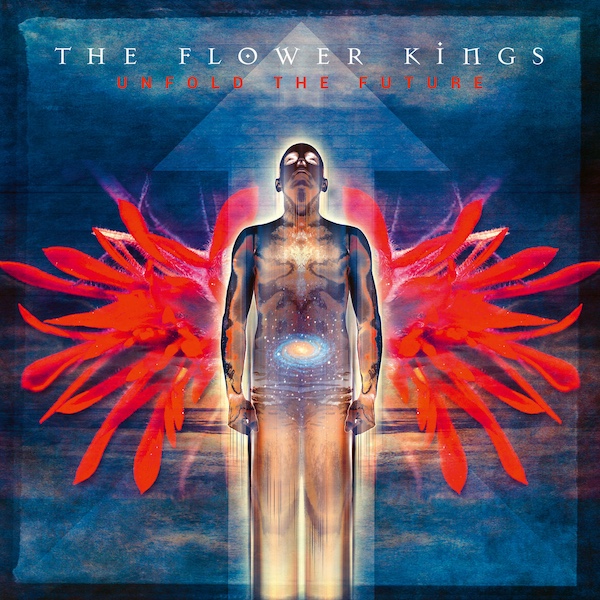
You would think after the somewhat muddled response to The Rainmaker and the first real significant loss of a band member (Jaime Salazar departs the drum kit), Roine Stolt would put a pause on The Flower Kings and regroup. Nope: here we are a year later with new drummer Zoltan Csörsz, an expanded lineup that includes returning sidemen Ulf Wallender and Hasse Brunisson and Pain of Salvation’s frontman Daniel Gildenlöw contributing backing and lead vocals. It’s also back to epic album lengths, with Unfold The Future clocking in at just over 140 minutes. Gone are the overt “let’s get metal” moments, replaced with more cinematic ambition and jazzier, loose explorations. Does it all work? Well, much better than The Rainmaker, yes. But for more you need to dive in after the jump.
The album opens with the massive 30-minute “The Truth Will Set You Free”, and for all the accolades paid to earlier classics, this might be my favorite of the bunch. There’s a cinematic feel to the opening, relying heavily on Csörsz and Brunisson coming together with some spectacular rhythms and odd percussion, followed by heavy synths and an expanded horn section. Themes are laid out, and when we get to the main melody Jonas Reingold’s bass is front and center, always a delight. As is hearing Hasse Fröberg taking the vocal lead. With this many albums in, the overt references to classic prog heroes like Yes are really falling away (though Stolt really channels some Steve Howe in his leads) and the only thing to really compare the band to is themselves. Reingold is – no surprise – an absolute beast throughout the track (and album) and his leads, along with Tomas Bodin’s keyboard excursions are a delight through the track. Stolt shines in a number of ways, particularly in the middle orchestral section where his vocals come in with acoustic strumming. It’s a beautiful break in the action before the second half resolves into the band’s finest epic to date, with recapitulations of themes that are fractured and demonic, allowing everyone to break out and show their crazier sides, especially Csörsz who makes the most of his debut with the band.
With so much scrutiny on the longer epics, I feel like a lot of folks don’t pay enough attention to the shorter songs, which make up about half of Unfold The Future. “Monkey Business” has a little more crunch in its opening riff, with some Zappa flair (my mind went to Overnite Sensation for a minute on my first listen) baked in. It’s also our first taste of Gildenlöw’s vocals, and reminds me more than anything else that I eventually will get to covering Pain of Salvation on the site. After a bit of a somber, lackluster opening “Black and White” kicks into fun gear with lots of playful Zappa flourishes (I guess we’re not done with older prog comparisons after all). “Christianopel” gives us both our first instrumental of the album and the first big co-writing credit, with Bodin, Reingold, and Csörsz contributing. More a free-form jazz exploration than a tightly arranged instrumental, it’s a new horizon for TFK, and despite the laid back groove Stolt slowly mesmerizes with his guitar work. Reingold is also restrained, but not invisible; he finds little corners to play in and nails every figure he lays out. This song was a big grower for me – the first few minutes I was ready to write it off, but credit to the band they manage to not only find their way but grab you in the process.
”Silent Inferno” is the next big track clocking in at 14 minutes, and it starts as a barn burner, super heavy and rocking but never sounding as forced as it did on The Rainmaker. I’ve read on forums that a lot of folks prefer the original mix and master, but listening to this I find nothing lacking, though that may be due to my lack of familiarity with anything but this version of the album. By now the formula is well know, so going into more detail here feels somewhat redundant, except to say that overall I’m really feeling the heavier jazz feel I assume Csörsz is bringing to the table.
Rounding out the first section (I’m reviewing the original track order via the CD rather than the vinyl sequence since that necessarily has to cut “The Truth Will Set You Free” in half) with the twee and fine “The Navigator” bringing out the brass flourishes and mellotron. Bodin hasn’t been mentioned enough so far, and I wonder how much he has to do with the orchestral arrangements. Finally there is the equally light and airy “Vox Humana” which gives a nice showcase to Fröberg’s vocals. I’ve also read on forums a lot of folks don’t like Fröberg’s vocals, and would just prefer Stolt sign everything? That’s insane, people. Half the wonder of TFK is how Stolt uses his many vocalists, as we’ll see on the second half of Unfold The Future.
The second half of the album kicks off with the rocking “Genie in a Bottle” and Stolt moves into blues rock territory, and he has a fantastic gritty tone to match the vibe, fully reinforced by Wallander and his dirty boy sax. But where I want to focus on is “Fast Lane” because 1) the music is all Bodin and 2) this is where we get our first lead vocal from Daniel Gildenlöw. You can probably successfully argue that TFK didn’t need another vocalist when you have two capable lead singers already, but listen to Gildenlöw’s vocal cadence and the way he handles the many, many syllables his has to wrap around the melody. Not saying Fröberg or even Stolt couldn’t do it, but do it as well? Not sure…I became a Pain of Salvation fan back in 2000 with the release of The Perfect Element Part I and a large part of that was Gildenlöw’s facility with syncopation in the band’s music and melodies. I’m not 100% sure what facilitated his joining the band (I think he was supporting them live on vocals and guitar and then came aboard) but I know it wasn’t a long tenure, so I’m going to enjoy it while it’s here.
Both “Grand Old World” and “Soul Vortex” are shorter pieces that work well as breathing room for the larger epic songs. Not particularly enamored of either, though there are plenty of nice moments: Stolt’s vocals and the way the songs opens into the brass notes on the former, and the percussion workout on the instrumental jazzy jam that is “Soul Vortex”. Gildenlöw returns to the mic for “Rollin’ the Dice” (coincidentally another Bodin credit) and it has a lot of Pain of Salvation in it before Gildenlöw even opens his mouth. I love hearing Bodin open up The Flower Kings’s songwriting a bit, introducing new flavors such as the darker spaces that inhabit this song. “The Devil’s Danceschool” is another jazz fusion excursion, more successful than both “Soul Vortex” and the slower, gentle pace of “Christianopel” – no surprise that I also find some Zappa mixed in with the obvious 70s era Miles Davis there.
I wish I had anything of note to say about “Man Overboard” with its pretty keyboard work and “Solitary Shell” which feels more like an interlude than anything else. They’re fluff before the storm of the 25-minute closer “Devil’s Playground” which is…fine? But coming after two hours of music there’s no way this is going to have the impact I think Stolt intended. I guess you can take the song on its own, and doing that there’s a lot of great moments – I really love the break around the nine-minute mark – but when you’re making an album you’re meant to take it as a whole, and despite this being an overall better album with better overall songs than both The Rainmaker and Retropolis I think the massive length is a detriment.
The problem is, what to cut? Maybe there’s a case to leave the two discs as they are but make them separate albums? If I was forced to make this one album, I’d have to drop one of the big epics, unless you’re cutting everything else out. I tried removing “Monkey Business”, “Christianopel”, “Silent Inferno”, “Vox Humana”, “Genie in a Bottle”, “Soul Vortex”, “Man Overboard” and “Solitary Shell” and I’m still 10 minutes over a standard CD length. In the end I think Unfold The Future is in the only form it could be in. Strong songs, weak album?
Does that make sense?
Take it in chunks and you’ll be fine…




 Consuming the Tangible
Leave a comment