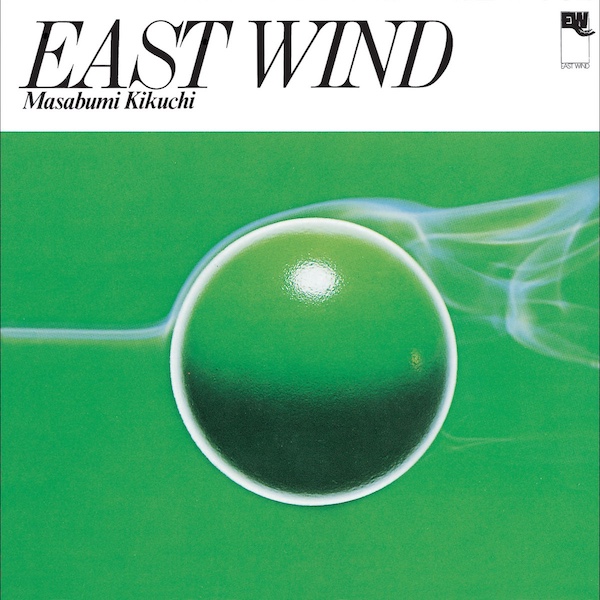
Moving on in our Japanese jazz excursion from Three Blind Mice to East Wind, established in 1974 that may not have lasted as long, but did its part to promote not only the scene coming out of Japan, but to expose and provide access in country for other musicians like Art Farmer, Sam Jones, and even Oliver Nelson. But it started with Masabumi Kikuchi, a pianist and composer who dabbled over the course of his in many different styles, and worked as both a leader and sideman to other jazz greats like Gil Evans, Paul Motian, and Pee Wee Ellis. His debut for the label, also named East Wind, is a juggernaut – 2 epic 20+ minute tracks that run the gamut of straight ahead hard jazz, a strong percussive sense with excellent solos thanks to a solid quartet of performances backing him up and pushing the compositions forward.
East Wind starts off with the 20-mimute title track, Kikuchi’s acoustic piano mixing with the other instruments to start the theme, with only bassist Juini Booth pushing his sound to the foreground. It’s an interesting dynamic to kick the album off, and a testament to Kikuchi’s strength in composition and arrangements. From there the solos start, first with Terumasa Hino (a name we’ll be hearing more from shortly). “Tuneful” doesn’t really capture the fluidity of Hino’s playing, but it’s the best I can do here. Kickuchi uses these stabbing, short chord bursts to accentuate Hino’s solo even as he serves to mind us of the harmonic structure, and drummer Eric Gravatt slays on the cymbals. Next up is trumpeter Kosuke Mine (another name that will pop up here this week), and his style feels more wild – I don’t want to use Miles Davis as a reference, but there’s something in the note choices (not the actual tone – only Miles could make that unique sound) and the push for excitement, extremity, that I really dig. When it comes time for Kikuchi’s solo, there’s a weird, almost disturbing vocalization coming through that sounds like a cat getting sick. I have no idea if it works, but it certainly stands out. Gravatt takes up the remaining slot (no bass solo here) and is fantastic before the band winds down.
Booth’s bass again finds itself opening the track, and the 23 minutes that make up “Green Dance” have something special that work for me better than the title track. Maybe it’s Kikuchi’s playing, much more up front and comping hard on the chords instead of just relaying the main melodic themes. That weird cat noise though remains, and I won’t lie – it’s a little distracting.This track also really show off the rhythm section – Gravatt adds a lot of small percussive elements like wood blocks and, locked in with Booth’s bass, creates a sublime bedrock fore the soloists. Those solos come, but it’s more the interaction between the band when they play in unison that make up the most exciting parts of “Green Dance”.
Overall East Wind is a great sample of one kind of music Masabumi Kikuchi could roll out. I’ve checked out a few of his other works, including the more jazz rock fusion of 1970’s Poo-Sun, and the electrified modern sounding One Way Traveller. But for straight hard jazz, this is a nice place to start on his career.






 Consuming the Tangible
Leave a comment