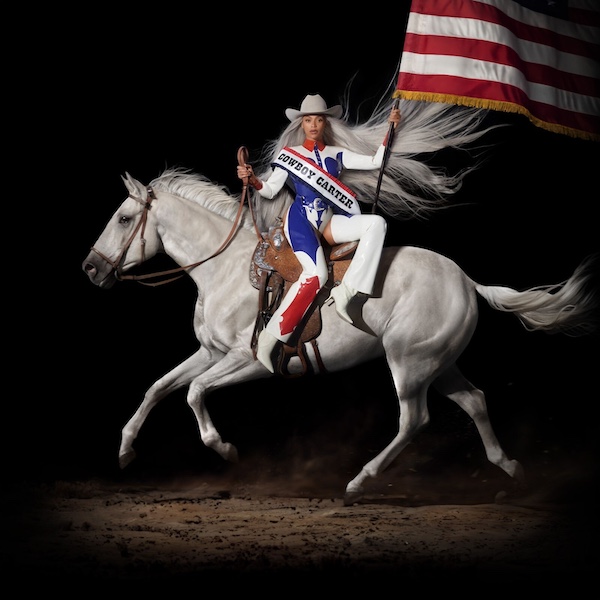
I put off writing about Beyoncé forever; what could I possibly add to the global conversation about one of the biggest artists in the world? Nothing. Even if you’re not a fan, you know exactly who she is, whether it’s from her time in Destiny’s Child to her incredibly prolific solo career, both as a performer and a producer. Chances are you know she’s married to Jay-Z, another legend of the scene. You probably know the drama, and her musical response (and his) even if you never actually heard them. As well: who doesn’t wag some part of their body when “Single Ladies” comes on? Anyway, that’s all mindless preamble to the fact that Cowboy Carter, the second in a three-act series of albums focusing on different genres (previous album Act 1: Renaissance focused on the liberating club and dance scene) has since release sat at the top of my list of incredible records, an album that not only brings the very best production I’ve heard on any record since, well…her last album, but also helped me to re-think my entire relationship to music.
I’m not going to go into the whole scene where Beyoncé was snubbed by the country and western music industry, a scene that has for decades tried to whitewash and homogenize the genre to a white pasty shadow of its former self. Instead I want to talk about Cowboy Carter on its own terms, not as a response to that snub but an acknowledgement of how an artist, even one who – gasp – uses a number of outside producers and songwriters can be just as ambitious and full of adventure and the year to explore all the nooks and crannies of this thing called music.
It starts with the songs, and the moment I heard opener “AMERIICAN REQUIEM1” I knew this was going to be special. Using country and americana as the firmament and the lens from which to view her perspective on the musical landscape it features a wicked interpolation of Buffalo Springfield’s “For What It’s Worth” that is alone worth the price of admission. That it segues into a beautiful cover of “Blackbird” with Paul McCartney providing guitar is an exquisite sequence that shows how far she’s reaching past any expectations her audience may have had in order to further her musical reach.
But is Cowboy Carter country? I mean, songs like early singles “16 CARRIAGES” and “TEXAS HOLD ‘EM” certainly play with the form (and I’ll add here that catchy as it is, Texas Hold ‘Em is easily one of the weakest tracks on the album) and tracks like the excellent “PROTECTOR” roll with acoustic guitars and an americana folk that speak to the dream of the West, rather than the notion of “country” music. And for every “safe” choice like her cover of “JOLENE” where she flips the lyrics for a more fierce admonishment of the unnamed woman (though we all suspect that nefarious Becky with her goods hair) there’s a left hand turn like the gorgeous “Daughter” with layered harmonized vocals and circular classical guitar riffs. Or “RIIVERDANCE” that brings in an urban R&B groove against a chicken pickin’ guitar. So yeah, it’s country…but it’s country on Beyoncé’s own terms, and if she wants to bring the 80s yacht rock with “Bodyguard” or slap some serious BRAP sounds to the hip-hop of “SPAGHETTII” she’ll do it, thank you very much. It doesn’t all work: her duet with Post Malone on “LEVII’S JEANS” is safe and bland, and I think I’m immune to the charms of Shaboozy on “SWEET HONEY BUCKIIN” but conversely I really love the duet with Miley Cyrus on “II MOST WANTED” so go figure.
There are also a number of shorter interludes and segues that are sumptuous and cozy and filled with lovely little moments, and it’s there that my true love for the album lies: the incredible production. Since 2016’s meteoric Lemonade I don’t think another artists has pushed the production side of their music to extent Beyoncé has. On Cowboy Carter the list of credited producers is longer than a novel, but names like Jon Batiste, No I.D., Pharrell Williams, and Raphael Saadiq are nothing to sneeze at. This album sounds incredible, almost (but true, not quite) as insane as Lemonade. Or Renaissance.
Which brings me to the last piece, what I learned by falling in love with the music of Beyoncé. Right now (but really forever) there’s been a lot of content creators of a certain age – my age, in fact – that bemoan the loss of “real” music in favor high gloss pop pablum that doesn’t even have real musicians playing their instruments, ferchrissakes! This is a purposefully reductive summation of a frankly reductive argument – rock is alive and well, thanks, and for all the talk of real instruments tell me how many of those bands you think are “real” musicians are actually not using any AI, whether it’s triggered drum samples, quantizing rhythms, or nudging a vocal line to be in key. But that’s besides the point. The argument that came to me is why would I disparage modern pop but not the pop of the 50s or the 60s? Great, fantastic singers and performers who had a whole business of musicians and producers and writers crafting their identity. Anyone want to tell me Aretha Franklin or Frank Sinatra or Elvis Presley2 weren’t completely in charge of their image, their music even if they weren’t there on the ground writing and playing everything? Sinatra was in complete control of his identity and knew exactly what he wanted…and he had Nelson Riddle to help him. Aretha Franklin had folks like Jerry Wexler and a bevy of great writers assist her in crafting some of the best songs of the 20th century.
If you think Beyoncé is the crafted product of dozens of producers, writers, and musicians and not the mastermind working with those producers, writers, and musicians to craft EXACTLY what she wants to put out into the world, I don’t know what to tell you. Go back and watch the Yacht Rock documentaries and play your Michael McDonald albums3 one more time.
You know where I’ll be…
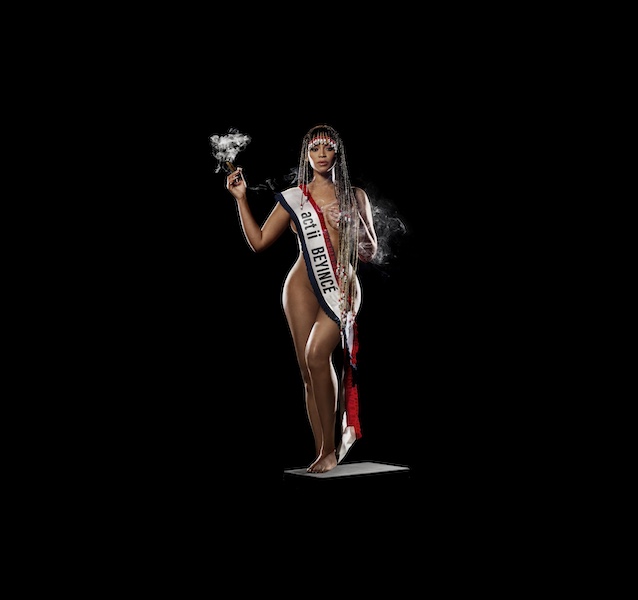
1 I have no idea what the meaning is behind the all caps, but apparently the double “i” in songs like “AMERIICAN REQUIEM (but not “16 CARRIAGES”) is meant to signify this is Act II. Consider yourself armed with new knowledge, I guess…
2 Okay, Elvis did have the Colonel shaping him, but don’t tell me the man didn’t also know what he wanted to be and helped to work with the people to shape that image.
3 To be clear I enjoy Yacht rock to a degree, especially Steely Dan, who are masterful musicians and writers. But who would Steely Dan be without help and assistance from Michael McDonald? Or Bernard Purdie? Or a number of other musicians and producers to help realize their vision?


 Consuming the Tangible
Leave a comment