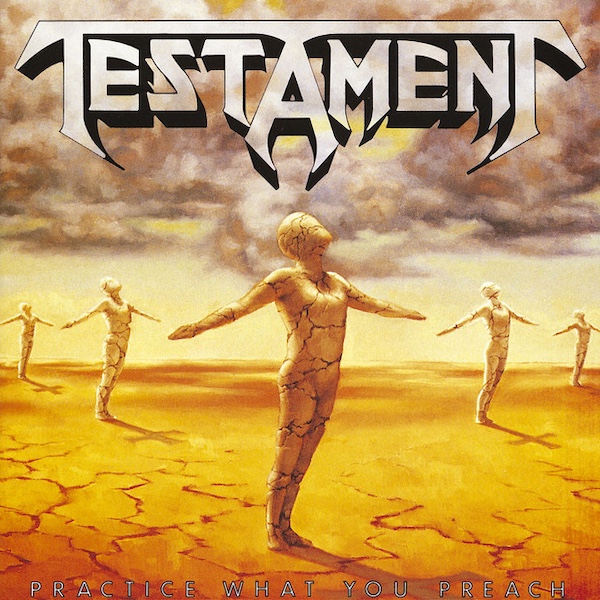
Where the lack of time and preparation may have marred portions (small portions, to be sure) of the sophomore effort by California’s Testament, the grind of tour/record/tour made the third time the charm. Practice What You Preach sounds fully realized, the band settling into their space, injecting more fusion and progressive riffs and arrangements while tightening the songwriting to produce the band’s most mainstream and successful album to date. Sure, you can hear obvious capitulations to getting on rock radio and MTV, but the anger and aggression of the heavy tracks are uncompromising, and as my introduction to the band it was the perfect entry point, allowing me to hear the balance between their earlier chaos and future major label tribulations.
It starts with that title track, my very first exposure to the band. I love how fluid and groovy the riff is, a far cry from the choppy, syncopated spider riffs of Megadeth or the ultra-compressed, viciousness of Metallica. Greg Christian’s pick attack on his bass is super audible, giving the song an audible crunchy roll throughout. Alex Skolnick kicks his solo off in half time, then the band picks back up and races with him as he shows off just how technical and dextrous a player he is. It’s also a shot across the bow: Practice What You Preach doesn’t have any interest in the fanciful dark evils of previous albums – in the late 80s there was enough evil in the world to populate thousands of albums, and they find ample fuel to propel the lyrical themes here. “Perilous Nation” has a lot of bite and bile in its lyrics, and it matches the tempo shifts and solo sections. It’s a song that’s only gotten better over time, and constantly fights for my favorite track on the album.
The rest of Side A plays with the mood a little bit. “Envy Life” has more of a mid-tempo stomp after its twisted lead intro, and it gets bluesy the darker it goes. “Time Is Coming” brings back some of the lift from the first two tracks, getting positively moshy with Louie Clemente’s slowed down blast beat in one of the song’s many bridges. It closes with “Blessed In Contempt” and I’d be lying if I said I remembered anything about the song before listening to it again on the re-issue…I probably jumped to the second side of my cassette to quickly get to “Greenhouse Effect” for…reasons, which will be divulged in the next paragraph. But listening now it’s a perfectly serviceable if slightly unremarkable song, lacking some of the heft of the stronger tracks across the Practice.
So yeah…”Greenhouse Effect” kicks off Side B and it was 100% my jam in high school. Reason being? For my 12th grade AP Government class we were asked to bring a song in with “political content” that we would sing to. I think every single girl banded together and sang Billy Joel’s “We Didn’t Start The Fire”. I had one friend do Living Colour’s “Open Letter To A Landlord” and he did the intro by Corey Glover a cappella. It was glorious. Me? I moshed to “Greenhouse Effect” (and with my buddy covered Mucky Pup’s “Reagan Knew”) and to this day I can’t hear the song without thinking about how red-faced I was as I gave it my all shouting “Environmental Holocaust!” at the top of my lungs. The opening to “Sins Of Omission” always sounded to me like the opening titles to Knight Rider or some other generic but awesome 80s action show (let’s hear it for Automan…anyone?). But this is another really strong song, lyrically letting me expel some serious demons with the line “There’s no reason for suicide” regardless of the context the line finds itself in, which is kind of wishy washy generic darkness and finding your way through it.
That brings us to the big hit of the album, if you want to call it that. “The Ballad” comes a year after Metallica galvanized the metal world with “One” and it seemed like every heavy band was suddenly trying their hand at a softer, acoustic track to make it onto regular rotation on MTV (it was the late 80s, radio barely mattered, especially to metal). It’s an incredible showcase for Alex Skolnick, whose solos are so exquisitely crafted you can instantly see why he was always in the conversation for best metal guitarists. And Chuck Billy shows an incredible amount of range in his singing, showing he could do more than just scream on key. It’s almost a shame when the song gets to its heavy part, although with the distance of over 30 years I can lightly laugh at how much the drum beat echoes what Lars Ulrich would pretty much live on for the last few Metallica albums.
“Nightmare (Coming Back To You)” is a speed metal closer in the vein off, well…let’s face it, this has a lot of Metallica DNA in it. But damn do I love the chorus, and at just under two and half minutes it shows how vicious and compact the band could get with their writing. After the two opening tracks this is probably my #3 song on the album. And it would be a perfect closer for Practice What You Preach, except they stuck the instrumental “Confusion Fusion” at the end, I guess so as to not completely ape the Metallica sequencing formula? It’s fine, nothing earth shattering, but when you have such a banger like “Nightmare…” I have to wonder what decision led you to not close on such a strong note. Regardless, the nostalgia rides very high for this album, and of the original mixes it sounds the best, producer Alex Perialas and the guys nailing the tone.
Now that my reissued vinyl is here, I’m sure Nuclear Blast will be announcing a remaster with crappy artwork in the next few weeks…


 Consuming the Tangible
Leave a comment