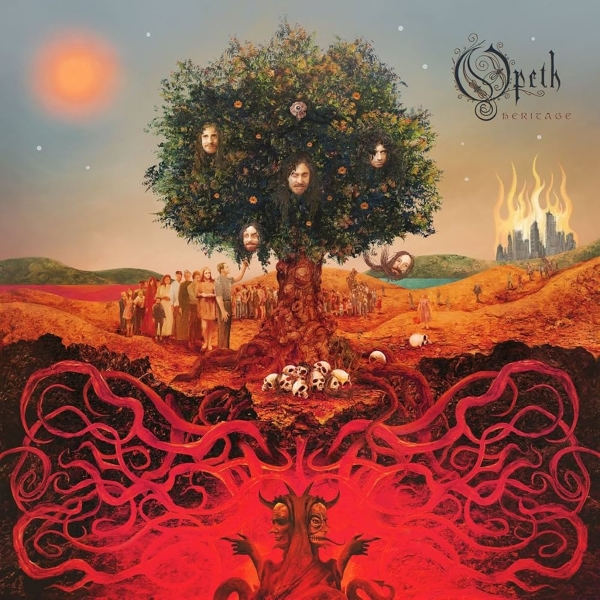
Make no bones about it. Heritage, the 10th “observation” from Sweden’s premier progressive death metal titans Opeth was the album they needed to make. Tired of trotting out the same (though unique to them) twisted melodic progressive death featuring incredible syncopation, lush keyboards and solos, and Mikael Åkerfeldt’s sublime death growls, the band needed to change gears to survive. So yes: there’s no arguing that this album needed to be made, and based on the – in my opinion – progressively more progressive and exploratory albums that followed Heritage absolutely succeeded in reinvigorating the band, whether you like the change in direction or not. Does that mean I actually like Heritage, though? On the occasion of the recent reissue of the album on vinyl I decided to wade back into the waters and see what I could find for myself.
It starts incredibly strong. The opening title track is literally an introduction, with the solo piano introducing the melodic theme of the album as well as introducing Joakim Svalberg, who would after this guest spot replace the departed Per Wiburg and remain with the band moving forward. From there it’s onto “The Devil’s Orchard”, hands down the most electric, exciting track on Heritage. Everything you would want from an epic Opeth song is there, the difference being the toned down distortion on the guitars and Åkerfeldt’s clean vocals, here taken to a whole other level from previous album Watershed. Wiburg’s organ (eewww) is up front, and Martin “Axe” Axenrot’s drums are fantastic: I know a lot of people complained when Martin Lopez left the band, but I loved Axe’s playing, and the combination of jazzy brush work along with his unique sense of rhythm really made for a great match with Åkerfeldt’s songwriting.
If I’m being honest, “I Feel The Dark” is a little too subdued for a third track, taking a little too long to ramp up in intensity. Which might be my honest complaint for a lot of Heritage: it’s not so much the lack of excitement as a lot of the songs feel half-baked, lengthy mood jams that take too long to resolve. Still, the second half of the song is really good, but that’s the part I wait for, rather than luxuriating in the whole song. Same with “Nepenthe”, a song I see a lot of love for. But is the love for the whole song, or just that great syncopated poppin’ funk section half way through? Not every song has to be as tight as the Rainbow homage “Slither” (maybe my second favorite track on the album) but I admire how Åkerfeldt can get all his ideas across in a more compact framework. Still, fantastic drum work by Axenrot.
The rest of the album typically falls into a morass of forgetfulness for me. But taking it in 15 years later, and understanding the progression that would follow, I find myself in a much better place with it. “Häxprocess” is the kind of slower, acoustic driven song I want from the band as opposed to the very tonally similar run of tracks on Damnation1. If there’s a highlight for me here, it’s Axenrot – again proving on the percussive intro of “Famine” with a assist from guest Alex Acuña that not only was he a great match for the band, in my ears he’s been the best drummer Opeth has had (that very well may change based on Waltteri Väyrynen’s tenure with the band). As the “epic” of the album closing in on nine minutes, it’s full of fun, featuring a great diabolical serpentine riff, huge booming organ, and some flute we now know Ian Anderson was asked to do, perhaps born to do. Alas, it went to Björn J:son Lindh who is great, but not Ian Anderson.
“The Lines In My Hand” brings in the mellotron to wonderful effect and continues the excitement from “Famine”. You can still hear this is definitively Opeth: bring up the chugging and add some death growls and this could fit anywhere in the band’s catalog from the last decade. Over a little too abruptly, though. “Folklore” is another creeper, gradually building to a galloping second half and at this point I’m left wondering if it was me, my attention span and inability to reconcile Heritage that kept it at arm’s length for as long as I did. Or if maybe “I Feel The Dark” is so soporific that it killed the momentum despite “Slither” coming in to save the sequencing?
I have no clue. As “Marrow Of The Earth” closes the album out I’m left with a new appreciation for how good Heritage is. Having it now on vinyl allows me to really focus on the songs, taking those small breaks to flip the sides. One complaint: for some reason Side A sounds really muddy, and “The Devil’s Orchard” in particular sounds abysmal. The rest plays fine, but it’s a weird thing.
Sorry, Heritage. I guess I do really like you, and may the fact that I double-dipped for the vinyl not only assuage my guilt but line your pockets just a little bit more.
1 You might revoke my Opeth fan club card for this, but I think both Deliverance and Damnation are the band’s two worst albums.

 Consuming the Tangible
Leave a comment