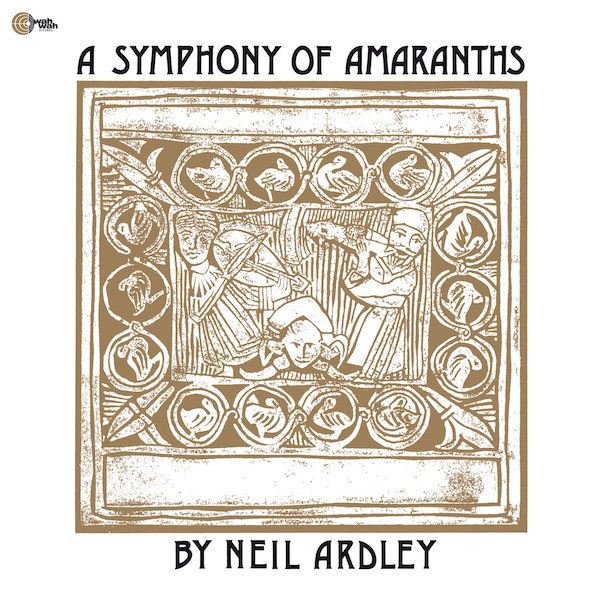
Man, what a delight. That was the first thing I thought to myself when getting swept up in the opening minutes of A Symphony of Amaranths, the incredible jazz orchestra composition from Neil Ardley, noted composer and writer of over 100 books on science, technology, and music. This was a complete blind buy: not being available on streaming services I only noticed it when browsing through the new stock on LaserCD and based on the description took a chance as I was already ordering a few other albums. I’m so glad I did; Ardley masterfully combines the two genres into a moving piece of art that is rich and vibrant and joyous, something my body and soul desperately required.
Conceived of and dedicated to the spirits of Duke Ellington and Gil Evans, the 25-minute performance is broken into four movements, with “Carillion” making beautiful use of an expanded jazz ensemble with orchestral additions to whip through a combination of written themes and improvised solos, notably from saxophonist Dave Gelly who worked with Ardley in the New Jazz Orchestra. Gelly also handles the glockenspiel which opens the number, using the notes DE and GE (the initials for Ellington and Evans) to serve as the foundation for which everything on A Symphony of Amaranths rests on. The sumptuous “Nocturne” is next, and it’s a gorgeous showcase for trumpeter Henry Lowther – his solo brings to my head the kind of romantic yearning found in black and white films from the late 50s. It’s anchored by some lovely vibraphone work and double bass, and in the liner notes Ardley mentioned this was always one of his favorite pieces of music. It’s lyrical and gentle and wistful without catering to schmaltz.
Improvised and recorded in a single take, the brief but ethereal “Entracte” takes advantage of the harp playing of Sidonie Goossens, who combines with Frank Ricotti’s vibraphone, Stand Tracey’s piano and Nelly’s glockenspiel to craft a light, dancing interlude before the final movement. “Impromptu” closes us out, beginning with a pulsing bass line that gradually explodes with the drums into a rushing boisterous big band swirl. Solos fade in and out of the driving rhythms, and the lush arrangements paints a picture of the city at nighttime, everything happening at once, the noise parting for burst of horns and stings of flute. It takes a reprieve halfway through to allow the harp and strings to punctuate a moment of melancholy before returning to the frenzy of the full band in a clash of bravado that ends with a spirited abruptness.
If the entirety of A Symphony of Amaranths was just the single piece it would have been more than enough to warrant the purchase and my current fascination, but the second “side” if you will of the newly re-issued CD contains some of Ardley’s more abstract pieces set to voice, specifically the recitation of a number of poems. First up is the wonderfully silly “The Dong With a Luminous Nose” from Edward Lear in 1887 and recited by Ivor Cutlet. Using the music to accentuate and underscore the line readings, it’s intentionally silly and nonsensical, and my first impression was a much more mature and structured execution of what Tull would attempt with “The Story of the Hare Who Lost His Spectacles” on A Passion Play.
Next is a series of three poems: W.B. Yeats’s “After A Long Silence” beautifully sung by Norma Winstone. It works as an almost Burt Bacharach love song, but Ardley’s dense arrangement and orchestration gives it a life that has more weight and heft than how I’d expect Bacharach (who I love) would handle it. From there Winstone also handles “She Weeps Over Rahoon” taken from James Joyce. It’s largely working in the same space, more wistful and longing than the previous recitation. Things finally spruce up with Winstone’s scat that opens the bouncy “Will You Walk A Little Faster” taken from Lewis Carroll’s Alice’s Adventures in Wonderland.
Each of the poems displays the rich harmonic depth Ardley could wield like a surgeon, and although they don’t equal the joy I got from “A Symphony of Amaranths” they’re a perfect partner to the album as a sequenced whole. There’s also a brief bonus track of Ardley blending the national anthem into a tango and leaving the band in laughter. It’s short, but the perfect way to leave me smiling after listening to this.




 Consuming the Tangible
Leave a comment