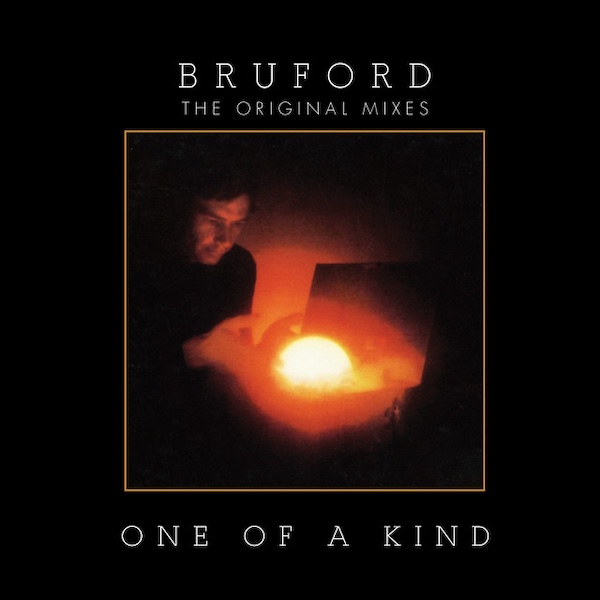
Somehow reading about and buying a lot of those Three Blind Mice and East Wind releases led me from Japanese jazz fusion over to what the rest of the world was doing with fusion. I decided to start filling gaps in my knowledge and collection with Bruford, the solo group project led by former Yes and King Crimson drummer Bill Bruford. One Of A Kind is his second solo album, moving the murderer’s row of talent he assembled for his debut into an actual group unit, including Allan Holdsworth on guitar, Dave Stewart on keyboards, and Jeff Berlin on bass. Yeah, it’s kind of U.K. Pt. II with this being where Bruford and Holdworth ended up after leaving that supergroup, but make no mistake about the genre: this is pure jazz fusion rather than any attempt at prog rock or pop.
I love Holdsworth, so the opportunity to hear him in a completely new context was exciting. And coming right at the end of the 70s where synths were starting to bring a little more of a pop sheen gives One Of A Kind a fun polish while still sitting firmly in the tradition of some of my favorite fusion bands like Return to Forever and Weather Report. “Hell’s Bells” bears that out with a fantastic opening melody on the synth that’s parsed out in a completely different way when Bruford’s drums kick in. Holdsworth’s entry is all bent out of shape, the man using his guitar to paint huge swaths of tones before moving into his unique legato runs up and down the neck. It’s so catchy, that melody hooking you with its modulated iterations.
The title track is split into two sections, with “Pt. 1” taking a bit of an ominous vibe before the actual vibes comes in courtesy of Stewart. “Pt. 2” has a bit of a pop vein running through it, with Bruford changing up the pace and rhythms while Holdsworth runs like the Devil over it. Things breathe a little bit with “Travels With Myself – And Someone Else” and the first thing I was reminded of – even before the guitars come in – is Pat Metheny’s work, particularly with Lyle Mays. Stewart shines here, as does Jeff Berlin’s bass work. His solo a little over two minutes in is a delight, and despite being the least “known” quantity he shows how well he fits in with the others. If there is any monotony or sameness in the tracks (always a concern when it comes to instrumental music) it’s broken by the Lewis Carroll inspired narration on “Fainting In Coils” which also distinguishes itself with some severe soloing from Holdsworth, adding drama to the track.
We return to our regularly scheduled programming on Side 2, with “Five G” being a perfect little funky fusion trip. Co-written by Berlin, Bruford and Stewart it makes maybe the best use of all their talents. Bruford never found a rhythm he couldn’t twist to his own devices, and as he shifts accents and prompts changes Berlin dances around the snap of the snare, with Stewart laying lovely chords down to provide a springboard for Holdsworth to do what he does best. Sitting squarely between his solo debut Velvet Darkness in 1976 and the genius (to me) of his 1982 follow-up I.O.U. I was most interested to hear his sole writing credit for the album, “The Abingdon Chasp”. And honestly was kind of shocked, though I shouldn’t have been. It’s a lovely, extremely accessible song, provided a great foundation for both Berlin and Stewart to take the lead melodically. There’s some sweet acoustic piano before Holdsworth steps in with his playing. It fits wonderfully with the rest of One Of A Kind even if admittedly it doesn’t quite distinguish itself like some of the other tracks.
A similar complaint could be levied at “Forever Until Sunday”with it’s maudlin first half, but once the track turns itself around and returns to the syncopated attack of the record’s first half it acquits itself admirably. That leaves the finale “The Sahara Of Snow”, like the title track divided into two parts and co-written with Bruford’s former U.K. bandmate Eddie Jobson (who also played violin on Forever Until Sunday”) and it’s an incredible closer, bringing forth the menace with rumbling bass and ominous keyboards until – like almost every fusion track – it explodes into a more joyous section. “Pt. 2” continues in a similar vein, and even as I’m not sure why it (or the title track0 was broken up into sections, it’s still an excellent to close out both One Of A Kind and my introduction to Bruford as a bandleader.

 Consuming the Tangible
Leave a comment