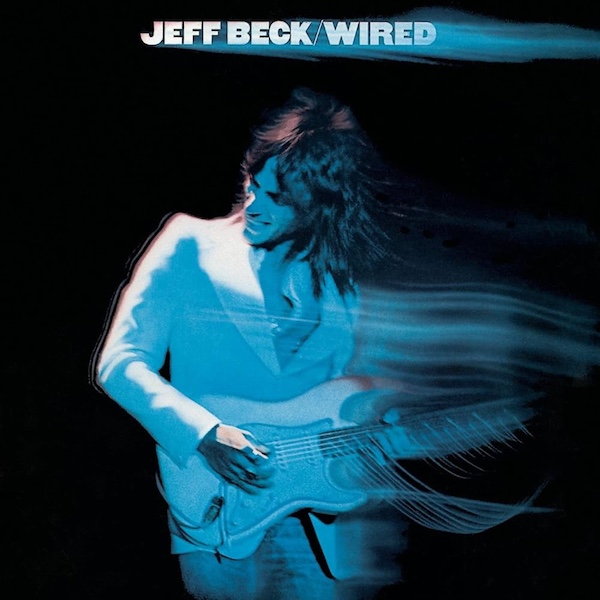
If my admiration for Blow By Blow was lukewarm at best, I wasn’t sure if Wired was going to be any better. A few more days spent watching tons of live videos showed me exactly what it is about Jeff Beck that was so influential: the guy was an absolute master when it came to dynamics, phrasing, and no one used the volume knob and whammy bar better than he did. Would that translate to a better studio album, especially one with a change of guard that now included some of the very same players who were inspiring him in the fusion world? I like Wired more: there are a few small issues here and there, but to my ears this sounds like the fulfillment of what Beck was shooting for on his previous album.
For Wired Beck relinquishes all the songwriting to his sidemen, and I think for the originals it does make a difference. The songs feel a little beefier, with some heft behind the rhythms. Max Middleton returns, contributing the opening track “Led Boots”, which, spelling aside, sounds nothing like an homage to Jimmy Page’s band and more like the funky instrumental rock Beck was pulling off on Blow By Blow. The difference here is Jan Hammer and Narada Michael Walden from the Mahavishnu Orchestra joining in on synthesizers and drums, respectively. Still under George Martin’s production, the tone is just a little darker and muddy, giving Wired a much needed shot in the arm. It sounds like a band jamming in a room as opposed to the much more clinical sterility of Blow By Blow.
“Come Dancing” is another funky number, letting new bassist Wilbur Bascomb come forward before Beck blows the roof off with his playing. It’s a highlight of Wired…or would be, if it wasn’t immediately followed up with Beck’s interpretation of Charles Mingus’s “Goodbye Pork Pie Hat”. That opening phrase shows you how much control Beck has over his instrument. It’s a gorgeous cover, and you can feel the entire band easing into a new gear. It then makes way for the very poorly titled “Head For Backstage Pass” and it’s basically a showcase for Bascomb’s bass playing, being the sole track he has a writing credit on. Short, fine, but nothing grabs and takes hold. It’s a brief enough diversion though, and lets you get to Jan Hammer’s “Blue Wind” which also features Hammer on drums in addition to his synth work. The primary melody is simple to the point of almost being obnoxious, but once he and Beck get rolling it serves as a launchpad to new and interesting solo places.
That leaves a trio of songs all written by Narada Michael Walden. “Sophie” is straight fusion, Walden’s drums getting busy and allowing Beck to shift through a number of different styles as the song alternates from lyrical and pastoral to more frenetic and busy. “Play With Me” goes back to the funky fusion rock and this is where Martin’s production shines for me: the soundstage is immaculate, but it sounds much more cohesive, the rhythm section binding the whole group together. Finally, it ends with the soft, delicate “Love Is Green”, another highlight for me.
It may seem weird that throughout this I don’t really talk about Jeff Beck. He’s the de facto leader, and the reason I took the dive in the first place. I think with Wired what I come away most impressed by is his willingness to be a partner: yes, his solos are uniformly sublime, not a wrong note played anywhere and a touch that isn’t afraid to be lost in service to another instrument. I think it’s important to call out his generosity as a leader, and if that means I lay back in this review to let the others shine, well…aren’t I just following Jeff’s lead?

 Consuming the Tangible
Leave a comment