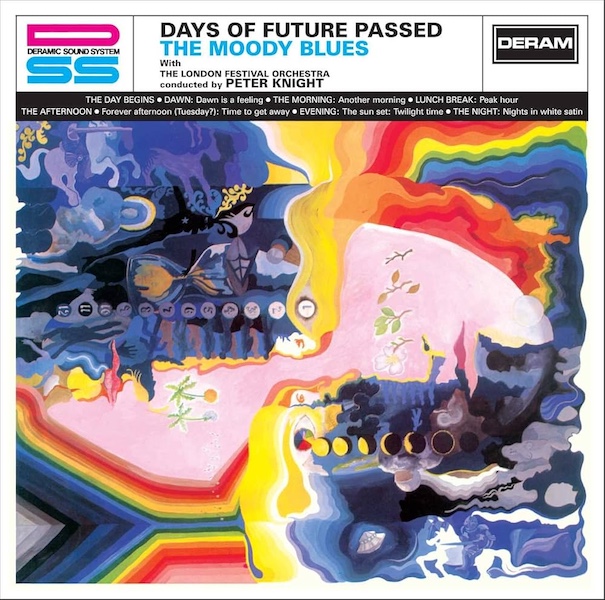
Let’s continue the trend with incredible album covers. I must have stared into David Anstey’s gorgeous collage of colors for hours as a child; Days of Future Passed was one of the few albums in my parent’s collection that was my mothers (the other was eponymous debut from Christopher Cross). But despite owning it I never actively played the music of The Moody Blues. I must have heard “Knights In White Satin” as a kid, probably on television and eschewed it for tunes that rocked harder. Once again proving you’re never too old, my fascination with progressive rock began leading me down peripheral branches, and that led to the particular chamber pop of the group, so here we are. Long story short: it was worth the rambling sojourn.
I think it’s tenuous at best call this a progressive rock album. Or even a rock album: there are moments of energy where you can hear the foundation of rock straining at the seams of late 60s pop like in the main body of “Lunch Break: Peak Hour” but this lush concept record (there’s that progressive aspect creeping back in, though there’s no narrative) about a day in the life, so to speak, embodies more the spirit and musical language Brian Wilson would drive forward. Pet Sounds had only come out a year earlier, and the Moody Blues leverage a lot of that progress for their sophomore record.
Sophomore record technically, but really for me and I suspect many others this represents their true “debut”. Working with the London Festival Orchestra, Days Of Future Passed features the arrival of Justin Hayward on guitar, vocals, and songwriting, as well as John Lodge who does everything listed above with the exception of being on bass instead of guitar. It’s also the start of the Blues’ working relationship with producer Tony Clarke, who would collaborate with the band for the next 12 years. The template is immediately set with “The Day Begins”, a two-part suite which features the album’s musical themes orchestrated and arranged by composer Peter Knight before jumping into “Dawn: Dawn Is A Feeling”. The heavily orchestrated chamber pop may ruffle those looking for more straight-forward pop and rock – it certainly wasn’t the best received album when released. But I think maybe we’ve hit a stage today with so many different styles haven’t been consumed into a much of whatever constitutes “popular music” now that maybe folks appreciate it more?
I do, though today as I write I struggle to reconcile whether it’s because of my life at the moment or just a maturity and growth having dug into so many genres and periods and regions of music.
I’m sure it’s both, and I’m sure one side of that equation lays heavier than the other.
Anyway, yeah: I really get a kick out of Days Of Future Passed. I love the oom-pah of “The Morning: Another Morning” and Ray Thomas’s vocals and flute playing. John Lodge’s “Lunch Break: Peak Hour” is great fun, and the fact that t that the band has multiple lead vocalists allow for some rich harmonies to come through. Mellotron dominates a lot of the album, and its presence on “The Afternoon” lends a slightly sinister air with Hayward and Lodge trading off both musical sections and vocals. And then there’s the massive elephant in the room. The album closes with “Nights In White Satin (The Night)” and it’s simply beautiful. Hayward’s voice is magnificent, and the music, paired again with a brief coda from Knight to close Days Of Future Passed out proper is sublime.
A true rarity, an instance where the music lives up to the beauty of the album art.
 Consuming the Tangible
Leave a comment