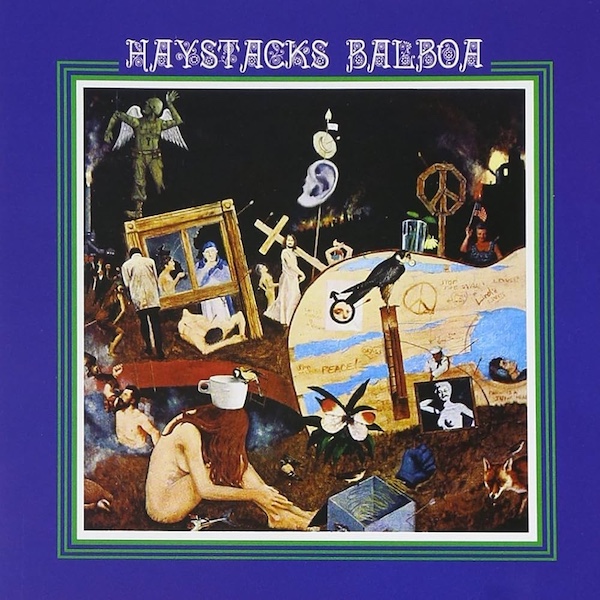
Another band lost to the either of the early 70s rock and prog brigade, Haystacks Balboa formed up in Forest Hills, Queens and hit the circuit hard, opening for the likes of Jethro Tull, Faces, Savoy Brown and Mungo Jerry. Their one and only album was produced by Shadow Morton, which is pretty much the extent of their listing on Wikipedia (under Shadow Morton, no less). What makes one band rise to the top, and another fall to obscurity? Listening to Haystacks Balboa again, I have ideas but no firm answers. There’s some real gold on the debut, but there are also the claw marks of inexperience, though not enough to turn me off to the band’s many charms.
One listen to “Spoiler” and you’d be wondering the same thing: it’s a terrific foot-stomping riff, raw and primal while holding gone foot in psychedelia with its heavy breathing and swooping vocals effects right before the solos. Lloyd Landesman’s organ playing is prominent, hitting accents alongside Mark Babani on drums when he’s not taking a solo. And guitarist Mark Mayo strings riff after riff together creating a patchwork rocker that never lets up.
And if the whole of Haystacks Balboa was in that vein, I think this would have be a stronger contender. Things take a lumbering, retro turn on “The Children Of Heaven” and the hard juxtaposition between the shambling distortion of the chords in the chorus against the jester-like fanfare of the verses doesn’t work, nor does vocalist Bruce Scott’s many affectations. He’s a fine singer, and when he’s laying down a more straightforward groove on something like “Bruce’s Twist” his slick, slinky voice meshes perfectly with the music.
With the epic nine-minute “Auburn Queen” I think I start to understand why Haystacks Balboa didn’t get further, and for that we have to talk about the prog aspects. 1970 was a great year precisely for being early enough that the concept of “progressive rock” was still being defined by the giants in the genre. So there was room to experiment and incorporate different things into what was common in the lanes of popular music and rock and roll. I think listening to “Auburn Queen” the progressive elements don’t mesh as easily with the other components – particularly the heavy psychedelia the band was still putting out. Having a trio of (mostly) straight ahead rockers on your Side A also doesn’t prepare you for the oddness of this track, and while I really dig it, there are slow moments (I’m thinking specifically of the theatrical organ break that goes for a weird ELP meets story time around the 6:00 mark) that bring the side down.
Side B repeats the formula, starting off with the nasty rock of “Sticky Finger”. Drummer Mark Babani really shines throughout the whole of Haystacks Balboa, but I love his work here, finding all this pace to whip around the kit with his fills. But then we take a huge pause for the nearly nine-minute triptych of “Ode to the Siken Men / Tell Me A Story / What Would Happen” and it slams the brake on the momentum the band built with the previous track. I can hear Led Zeppelin in their attempt to be grandiose, and the chorus is certainly catchy ( I admit I was singing “We Are the Silken Men!” on my evening walk, much to the chagrin of my wife) but when the vocals devolve out of rhythm it’s more annoying than anything else. The second section is really just a pretty acoustic interlude from Mayo before the band reprises that chorus.
“Riverland” is a pretty enough if simple closer, content to drift along until the needle bumps the label. I think had the band lasted a little longer there’s more than enough promise to refine and solid their sound into something quite good. As if it, Haystacks Balboa is a curious fun nugget to seek out of you’ve spun your Grand Funk Railroad and Dust records to death.

 Consuming the Tangible
Leave a comment