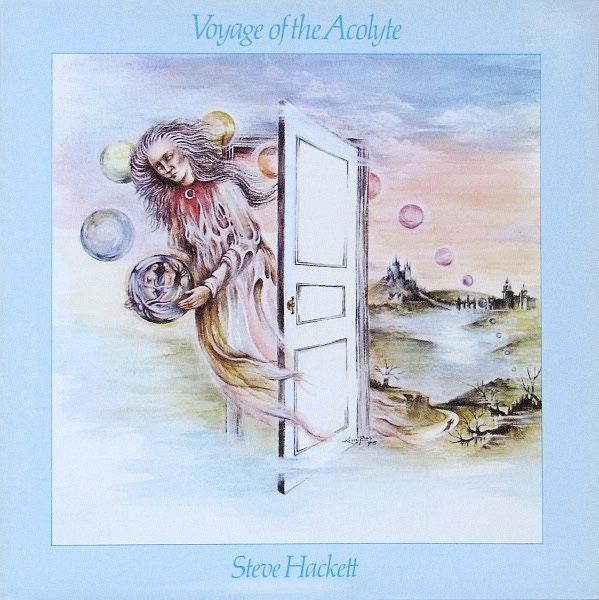
It was a difficult walk. We had a fight just before then, and because I wasn’t sure if it was going to continue I kept my headphones off in case I needed to listen and respond. She put hers on first, and I I did the same, reaching for something to get lost in. I’d been so enamored of Steve Hackett and his live series of discs covering large swaths of the Genesis catalog I had largely foregone his actual solo output. I found a great 1st US pressing of his debut Voyage of the Acolyte on Discogs, spun it up (virtually) and proceeded to get lost.
With pieces of the album reaching back years, it was an album constructed out of necessary, the toils and tolls of being on the road supporting The Lamb Lies Down on Broadway being particularly difficult for Hackett, who was already being pushed further back in the shadows of Gabriel and Bannks. So when the time opened to record, the concept of tarot cards and premonitions and much of the music was already formed. Wrangling in bandmates Phil Collins for the drums and Mike Rutherford for bass and assorted guitars somehow doesn’t make this sound like another Genesis record; Hackett’s fusion chops come to the forefront on opener “Ace of Wands”, a wicked instrumental that hides in its arrangements the classical touches that would come to dominate so much of Hackett’s style.
That sound is further reinforced with the presence of his brother John Hackett on flute and synthesizers, prominent throughout but featured strongly on the tw0-part “Hands of the Priestess”. Hackett’s melody is reminiscent of what he would bring to songs like “Firth of Fifth” instantly stuck in your head and hummable for days. The two sides of the tracks are separated by the ominous bass and synth-heavy tread of “A Tower Struck Down” As related to the Taort, it’s a card signifying destruction and that the chaotic menace of the track does a great job of bringing that sense to the music.
Side A ends with the first vocal piece, and while “The Hermit” is a fine song, with Hackett’s voice and guitar bringing a madrigal quality to the short turn, it’s just a trifle limp, especially when compared to the opening of Side B. By this time Phil Collins was already a force as a singer, and having him take the lead on the lovely extended “Star of Sirius”. Collins’s voice is racked along Hackett’s and the song alternates between a gliding fusion and more pop-oriented progressive rock. It might be the most Genesis-sounding of the songs on Voyage of the Acolyte even without Collin’s vocals.
After the solo classical guitar instrumental “The Lovers”, the highlight for many is the 11-minute closing epic, “Shadow of the Hierophant”. Again Hackett relies in his acoustic playing, and the classical, baroque nature of the opening is made stronger by the voice of Sally Oldfield, sister of Mike Oldfield. It leans into that heavy melody that opens the track, again echoing there kind of line he uses on “Hands of the Priestess”. It’s enjoyable, but where I find the joy is when the song opens up about five minutes in with the arpeggiating keyboards right before the solos breaks. I wish it would move into a faster gear, but the song instead grows in intensity and dynamics, getting closer and closer without accelerating.
Overall Voyage of the Acolyte is a fine, even interesting album that showcases what Hackett was occupied with as he was falling into the back of the Banks/Collins/Rutherford idea shop in Genesis. It would be a few years and a post-Genesis world before he would return to a solo venture, and this might be contrary, but I think I really prefer the abrupt left hand turn he took there.
We’ll hit that one next.

 Consuming the Tangible
Leave a comment