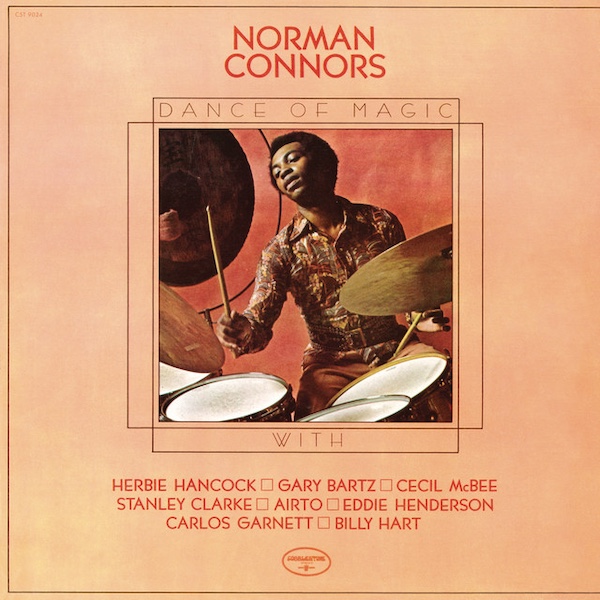
I wasn’t planning on this being a jazz-heavy week, but after listening to the fantastic Les McCann album, I turned to see what other unlistened CDs and records I had lying around and recalled the 2-for-1 disc featuring the first two albums of drummer Norman Connors as a bandleader. Although he’d be more known for his smooth R&B soul jazz in a few years with hits like “Betcha By Golly Wow” and “You Are My Starship”, Dance of Magic shows the man in hardcore jazz mode with a killer lineup helping to bring his vision to life. Also like McCann, it features one massive side-long track followed by a few shorter numbers, but the improvisation and genre mixing goes in both a smoother and more avant-garde direction.
One look at the cover shows you just how good Connors’ lineup was: Herbie Hancock on acoustic and electric piano, Stanley Clarke and Cecil McBee on bass, and an assortment of percussionists and horns including Eddie Henderson on trumpet and Gary Bartz on saxophone. Everyone is put to use on the opening title track, which starts firmly in the post-bop vein (it’s also largely acoustic) before the solos venture out into more free jazz territory. Throughout Connors and his stable of percussionists (Nat Bettis, Alfonse Mouzon, Babafemi and Tony Wiles) keep the rhythm driving forward, creating a stew of accents and syncopations that engage while laying down the bedrock for the soloists. I always find it interesting when drummers compose, and you can hear Connors playing with a myriad of forms, including that smoother soul sound he’d soon depart for.
But first, some jazz. After the title track Side B moves to three shorter tracks, and “Morning Change” written by Cecil McBee has a latin flair to its melody and percussion that brings the funky side of Connors a little more up to the front. The melodies are a little more straightforward and catchy, and when the horns come back to restate the main theme at the track’s end you get some great flute soloing from Art Webb.
“Blue” is a Stanley Clarke composition, and features Hancock on electric piano and Webb’s flute again for a nice, meditative flow. Clarke’s bass work is a standout here, and I really love this period where we’re getting this early fusion with (mostly) acoustic instruments. You could imagine this being a lot more fiery, with electric guitar and keyboards blazing away but Connors and his crew opt for a sonic spread that is dense and layered without sounding like it’s the results of digital amplification.
Did that make sense? I don’t know; I just know that I really enjoyed how “Blue” plays out, and how throughout Dance of Magic so many percussion pieces work to create this vibe that’s playful and smooth (I can’t stop using that adjective – the music just has a flow I enjoy), never stepping into a place that feels out of step. If that sounds like the drumming is subdued, then Connors has you covered with the brief closing track: “Give the Drummer Some” is a monster drum showcase, just over two minutes of incredible playing and soloing that shows just how formidable the man could be.
Fun stuff, worth checking out if you enjoy the period.


 Consuming the Tangible
Leave a comment