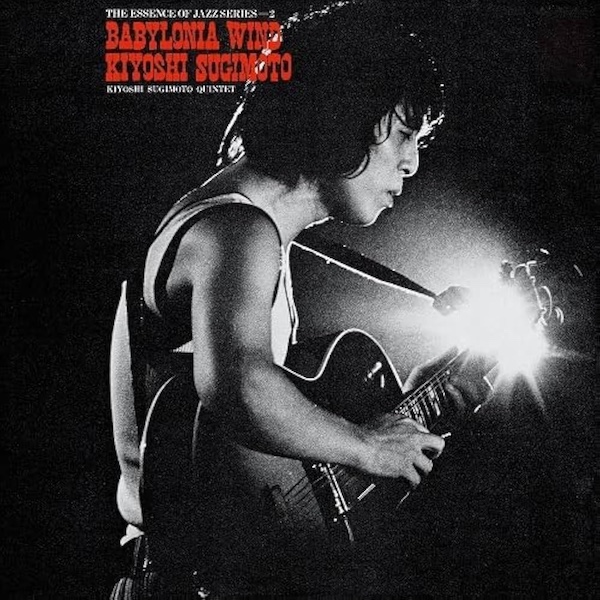
Would you look at that? Japanese jazz that’s NOT on Three Blind Mice or East West Records. Earlier this year saw the vinyl release of Babylonia Wind, the 1972 record from guitarist Kiyoshi Sugimoto and his quintet. Beautifully packaged as part of the Deep Jazz Reality series from Universounds, the Tokyo record shop and reissue label run by Yusuke Ogawa, it’s another hidden gem in the early 70s jazz rock revolution. I don’t know if I’m equipped to compare how this fares with a lot of what was on the rise at the time: this isn’t Miles Davis levels of fusion and jazz rock, but Sugimoto’s guitar is definitely wailing with a rock god fervor over the course of the album’s five tracks.
The opening title track has everything I love about this era of jazz. And about the way Japan recorded and evolved their sound – you can hear the quintet talk, sing-along phrases, and basically sound like a group feeding off of each other in a small room should sound. Backed by Takao Uematsu on saxophone, Yoshio Ikeda on bass, Hideo Ichikawa on piano and drummer Motohiko Hino, Babylonia Wind can veer from the scattered, drifting notes that coalesce into gorgeous solos on the title track to a more rock attack on the similarly fantastic “Mrs. Darius.” Sugimoto lays down a ripping rock solo, and Hino’s drums are alive and vibrant and up front to lead the charge.
There’s a touch of Isaac Hayes on Hino’s opening cymbal attack to Babylonia Wind‘s centerpiece, “Rosetta Stone” and again, that scattered electric piano reminds me of the way Davis’s In A Silent Way would slowly condense from these disparate sounds into a lovely song. Sugimoto raises the gain on his tone and puts out a truly devilish solo, at moments sounding like John McLaughlin in his less frenetic moments. The drumming is INCREDIBLE, and I keep finding myself drawn back to how Motohiko Hino is not only playing around everyone, but surgically using other percussion to accentuate moments of sublime improvisation.
“Colsabard Hill” might be the most standard of the five tunes presented on Babylonia Wind, with a straight, strong melody emphasized by Uematsu’s sax before Sugimoto lets another lengthy solo fly. Finally, there’s the brief “Hieroglyph” which really shows the facility Sugimoto has with the instrument. Rapid-fire arpeggios and licks race against a backdrop of Ichikawa’s piano and sparse bass runs from Ikeda. In some ways this might be my favorite track, showing off as it does all of Sugimoto’s strengths as a player.
I realized as I was writing that this wasn’t my first exposure to Sugimoto’s playing. I was similarly impressed with his performance as a sideman in Terumasa Hino’s band on his Live In Concert album. Just goes to show you that sometimes the reasons for a given purchase might reside further back in your mind that you realize.



 Consuming the Tangible
Leave a comment